

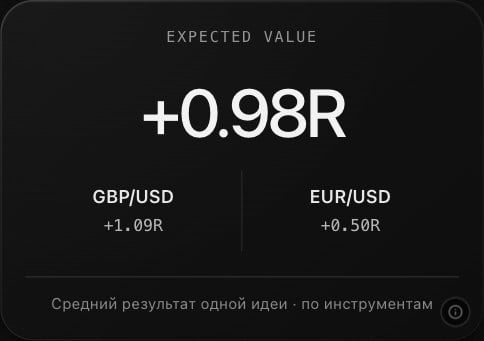
Expected Value in Santrade is a historical average of signed results in R. A profit contributes a positive value and a loss a negative value when a usable risk basis is known. The word “expected” does not mean that the app has estimated what the next trade will earn.
Read it as a summary of the selected completed history. Its denominator is the whole included closed sample, which is why one unknown R can make this metric unavailable even while other cards still show numbers.
Establish a signed R for each result
With known positive cash risk, signed R is actual P&L divided by that risk. A +$200 result on $100 risk is +2R. A -$100 result on the same risk is -1R. A BE label with a -$10 cost on $100 risk contributes -0.1R.
The cash sign matters. A result label does not turn an actual expense into zero for this calculation. When you inspect a surprising mean, check both the saved monetary amount and the risk used to normalize it.
The distinction between money and R is useful here. Money establishes the outcome; risk establishes the scale against which that outcome is expressed. Neither should be revised merely to produce a preferred average.
Calculate a small complete sample
Suppose the history consists of the three results above: +2R, -1R and -0.1R. Their sum is +0.9R. Divide by three completed observations to obtain Expected Value of +0.3R per observation.
If the BE record instead has exactly zero P&L, its signed result can be zero. The corresponding sample becomes +2R, -1R and 0R, with a mean of about +0.33R. BE belongs in this denominator, unlike its treatment in Win Rate.
Keep the actual count beside the value and inspect the underlying records before explaining a difference between periods.
Resolve missing inputs without shrinking the sample
For a non-BE record without usable cash risk, the calculation can use a known saved RR magnitude with the appropriate sign. That makes the source and meaning of older RR values worth checking. A zero-P&L legacy record may require particular attention to its result label.
A BE record with zero money can provide zero R without a risk denominator. A BE record with a nonzero monetary result and no usable risk cannot supply a known signed R. The amount alone does not tell you its normalized size.
Expected Value is available only when every included closed observation has a known signed R. If one is unknown, Santrade leaves the mean unavailable. Removing that record simply to reveal a number would change the sample rather than resolve its missing input.
Contrast the signed mean with other metrics
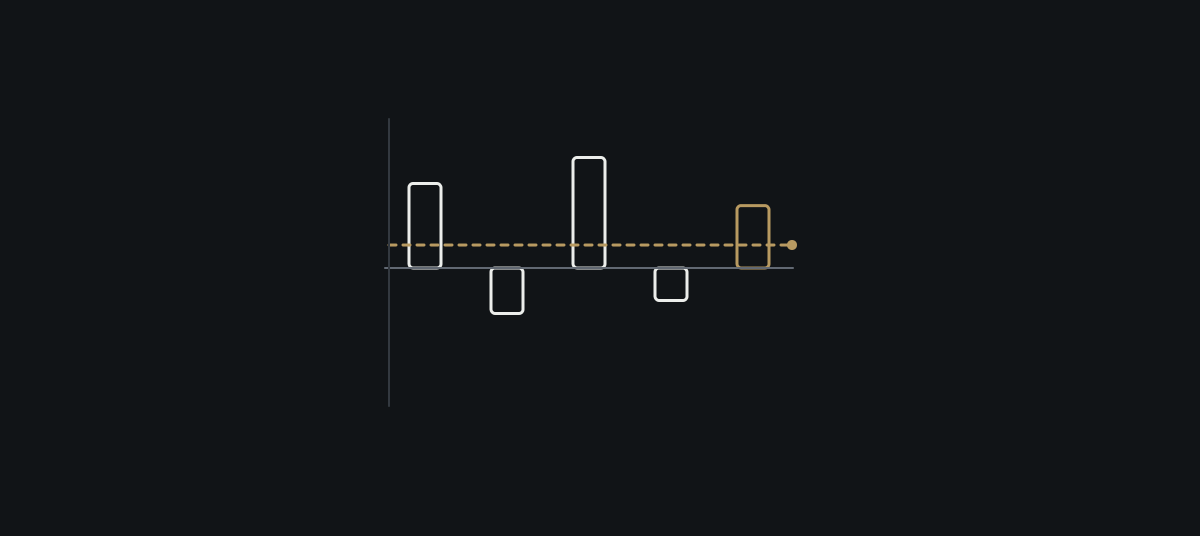
Average RR uses known magnitudes and excludes BE. It can remain visible when some magnitudes are missing. A large loss can raise that unsigned average, while lowering the signed mean used for Expected Value.
Profit Factor uses positive and negative cash sums and does not require a risk basis. Payoff Ratio compares average known R magnitudes on the two monetary sides. Each measure preserves a different part of the history.
A valid cash ratio beside an unavailable Expected Value is therefore a prompt to inspect R completeness. It is not a reason to force the metrics to agree or to interpret the unavailable value as a confirmed zero.
Keep the observation unit consistent
At idea level, linked account executions are combined before their R is calculated. The combined cash outcome is divided by the combined known cash risk. Adding each execution's signed R as a separate observation would produce a different mean.
A single-account scope may show the execution on that account instead. An idea with only one closed execution and other unfinished members also needs careful reading. The metric uses completed information, not a forecast of the remaining open outcome.
For a comparison, retain the date range, account scope and completed idea count. Check whether changes in instruments, setups or risk amounts accompany the change in the average. The mean itself does not isolate which of those differences matters.
Turn a change into a source check
When Expected Value changes, start with the records that entered or left the period and any corrected risk inputs. Inspect large positive and negative R values as well as newly available ones. A unit error can change the average without any change in trading conduct.
Write an observation with its scope, such as “The selected completed history averages this signed R, with a known R basis for every included idea.” Then note the next question the records can answer. A positive historical average remains a description of that history, with its particular scope and inputs.