

An entry reason can appear in many winning trades because you use that label frequently. To examine its place in your history, include the losses and BE outcomes that carry it too. Start with the definition of the reason and a clear description of what you mean by a successful result.
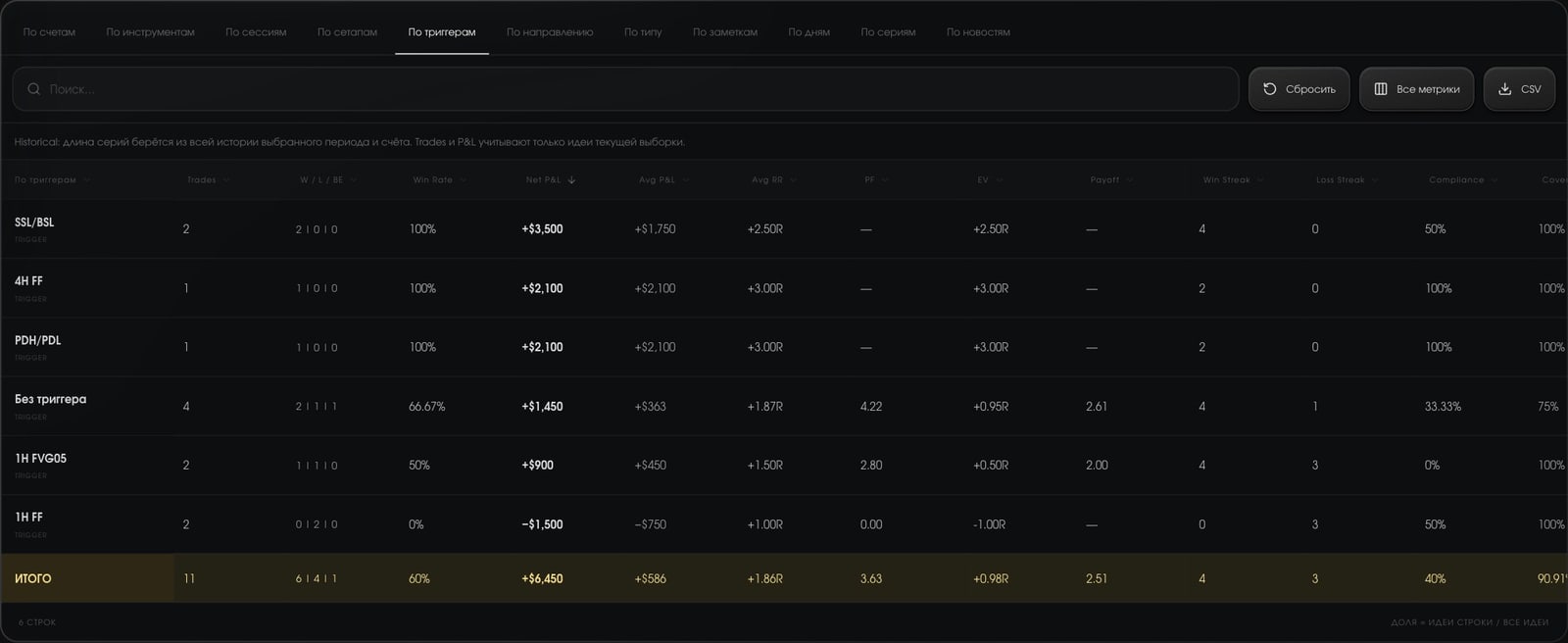
Santrade can group ideas by recorded reasons, shown as Triggers in relevant controls. Multiple reasons can belong to the same idea. That makes coverage, overlaps and the selected combination important parts of the review.
Define the question before selecting winners
Choose whether you are examining money, signed R, outcome frequency or a recorded process condition. These are different meanings of success. Write the period and account scope beside the question before inspecting the rows.
For example, “How do all recorded ideas with Checklist complete compare in this period?” leaves room for every outcome. Starting with TP alone would describe only the winning part of that label's history. It cannot show the complete pattern you wanted to inspect.
Check that the label has a stable meaning
Read its catalogue description and a few original records. A short label should refer to something you can recognize consistently, not a different explanation invented for each result. The distinction between a model and its entry reasons helps keep the definitions usable.
Santrade allows up to ten reasons on a trade. Select supported conditions, and keep event-specific circumstances in the comment. Adding a reason during a later review should preserve the fact that it was added later where that timing matters.
Inspect the unlabelled area
Use the no-trigger option to check how much history lacks recorded reasons. A missing label does not prove that the original entry had no basis. It may mean the information was never saved or cannot now be established.
The workflow for finding missing details can help separate supportable updates from unknown cases. Keep those unknowns in your account of the comparison instead of silently treating the labelled portion as the entire history.
Count overlapping rows correctly
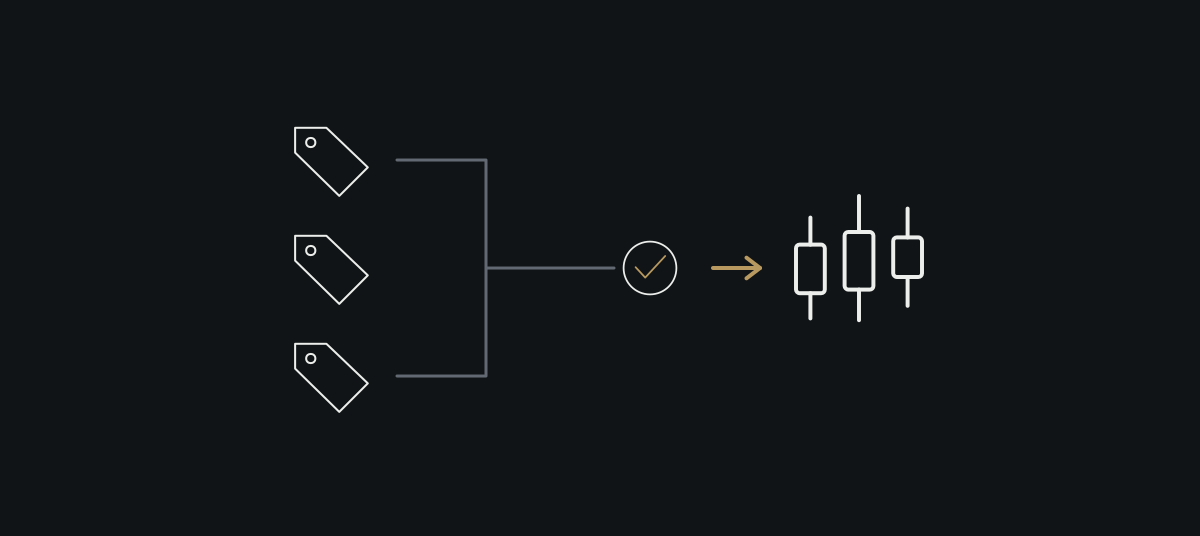
Suppose three ideas have these labels: the first has Checklist and Context, the second Checklist only, and the third Context only. Each reason row contains two ideas. Adding the row counts gives four memberships, although there are only three distinct ideas.
Each row's share is about 66.67% of the three-idea sample, so the shares add to about 133.33%. That is possible because they overlap. It does not create a fourth decision or mean the total should count the first idea twice.
A shared positive result can contribute to both reason rows. You therefore cannot add the rows' money results and call that the sample's net profit. The overall total is based on the represented ideas without repeating them for each tag.
Read a selected combination as an intersection
When several entry reasons are selected in the filter, Santrade requires the selected reasons together. In the three-idea example, selecting both Checklist and Context leaves the first idea. It does not select every idea that has either reason.
Linked account executions also need attention. Reasons are combined at idea level, so a selected combination can reflect labels attached across the idea's members. Expand the executions if your question is about which conditions were recorded for one account specifically.
Keep the selection visible in your notes. Changing from a single reason to a combination changes the question and often the number of observations. A strong-looking result from one remaining idea has a narrower basis than a full reason row.
Return to decisions and possible differences
Inspect original records from both monetary sides. Were the conditions documented at entry, added later or uncertain? Did the setup, instrument, risk or period composition differ between the groups you are comparing?
You can use a setup comparison as a separate view of the same history, while keeping its observation unit clear. A frequent reason among winners does not establish that the reason caused the wins. It may be common across losses as well, or occur with other conditions you have not separated.
Separate the finding from the next test
Save the definition, scope, known coverage, overlapping labels and exact selection used. A useful conclusion can be modest: the reason occurs in these recorded ideas, with these outcomes and these unresolved gaps.
If the pattern suggests another question, write it before changing the filters again. The filter-overfitting check helps retain the alternatives you tried.