

A session comparison depends on how the labels were assigned. If “LO” means one time window in part of your history and another later, the row can combine different circumstances under the same name. Start by checking the definitions before interpreting which session has the largest result.
The journal's session labels organize your own records. They do not automatically establish when an imported execution occurred relative to every market's opening, or recommend a time for your next entry.
Confirm the clock behind each label
Read your session definitions and the catalogue. Santrade includes standard labels and supports custom session codes and names. The session is selected manually in the trade record; it is not automatically assigned from the broker timestamp.
The settings reference states its winter and summer schedule in GMT+3. A profile timezone does not turn that reference into a universal automatically converted market timetable. Check the clock and any seasonal convention used by your own definition.
The session configuration guide explains these settings. For an analytical comparison, retain the definition used for the historical sample, including any date when you changed it.
Choose a scope and include the gaps
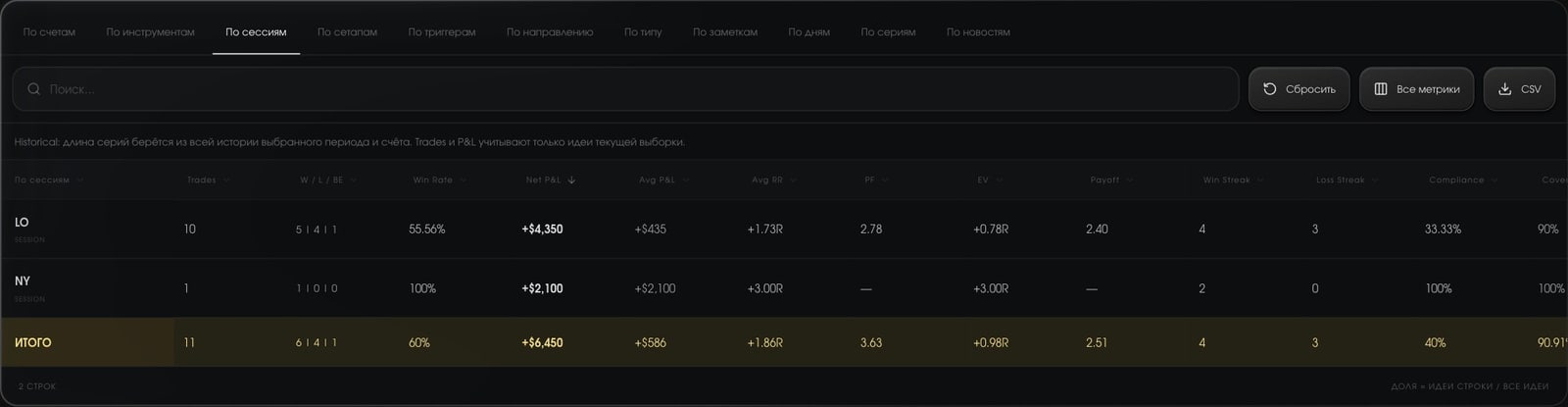
Select the period and account scope in Deep Analytics, then use the session breakdown. Check the no-session sample as well as the named groups. A missing label means the session was not saved; it does not establish that the trade occurred outside all relevant windows.
Complete only what you can support. The workflow for finding missing details can help build a small queue rather than applying the most plausible label to every old record.
If two sessions have unequal counts, preserve that difference in your review. A strong-looking average from a few ideas is a different observation from a broadly represented group, even when both appear beside each other in the table.
Read what Best session actually ranks
Dashboard's Best session orders recorded sessions by net P&L in the selected period. It includes closed executions with a saved session, along with realized RR magnitude, earned and lost amounts and leading instruments.
The word Best refers to that historical cash ordering. It is not a signal that you should enter during the first session shown. Its session counts use executions, so they should not automatically be called independent trading ideas.
Deep Analytics strategy breakdowns represent linked records at idea level. Keep the screen and observation unit clear when comparing counts. A difference between an execution-based summary and an idea-based group needs a scope check before an explanation about your routine.
Inspect risk, instruments and models within the groups
A session with more P&L may contain more ideas, larger risks or a different instrument mix. Another may include a model you used less often. Those differences can accompany the session label without being caused by the time window.
Read actual money and the available R measures together, with their definitions. Check the completeness of risk inputs before interpreting an unavailable Expected Value or comparing Average RR values. Also retain losses and BE rather than examining only the winning session entries.
If the pattern seems concentrated on a particular weekday, make that a separate weekday comparison. Record the added condition. Otherwise the original session question can quietly become a search for the most attractive session-and-day combination.
Return to the actual decisions
Open examples from each session's profits, losses and ordinary smaller outcomes. Read the plan, comment and saved images. Were the entry conditions documented? Was a management change explained? Which observations were saved at the time and which were added later?
A lower monetary result alone does not establish fatigue, distraction or a poor routine. Where you recorded such a personal observation, keep it tied to that record. Use it as something to review, without supplying a diagnosis for every entry carrying the same session label.
A sample finding could say, “This session's result is concentrated in one instrument and two large ideas; inspect those entries before comparing the routine.” The wording points to evidence you can check rather than a rule about the clock.
Save the comparison and its limits
Retain the dates, accounts, session definitions, counts and missing-label area. State which measure differed and which source records need follow-up. This makes it possible to revisit the observation without reconstructing the selection from memory.
The filter-overfitting guide helps when additional conditions keep improving a past subset. A useful session review describes your recorded history under a stable definition.