

Before asking which instrument you trade most consistently, define what consistency means in the review. You might mean applying recorded rules, using stable labels or obtaining less uneven results within a particular history. Those questions need different evidence.
Santrade provides instrument filters and breakdowns, but it does not assign a universal consistency score or identify the right market for you. Give the comparison a concrete criterion that you can check in your own records.
Choose the criterion before sorting
If the question is rule execution, use saved assessments with known supporting conditions. If it is documentation, inspect missing context. If it is the composition of outcomes, read count, money, risk and the individual contributions that make up the total.
Write a sentence such as, “I want to compare how often my recorded checklist condition was followed across these instruments.”
Keep the criterion stable while inspecting the first results. A change from rule-following to monetary profit is a new question, even if the same instrument happens to lead both views.
Confirm that the symbols mean what you think
Check the instrument names against your sources and catalogue. Similar provider codes or suffixes can split one intended comparison, while a reused label can combine records you meant to keep separate. The instrument settings guide covers the vocabulary behind the saved entries.
Choose explicit dates and accounts. A comparison across unlike account sizes or different periods can combine changes in funding, models and execution conditions. Preserve those differences rather than attributing everything to the symbol.
Linked account executions also belong to an idea-level representation in strategy analysis. When members disagree, inspect them. The instrument shown for an aggregated idea is not a promise that every member supplied an identical independent example.
Read the breakdown without giving its order extra meaning
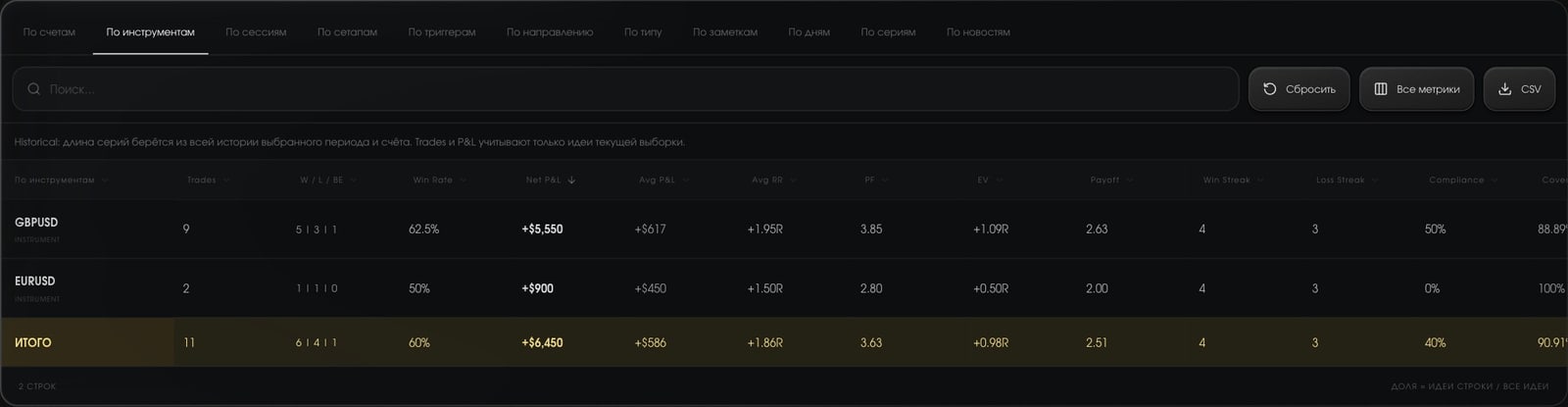
Deep Analytics has an instrument breakdown and filter. Dashboard shows instrument-level P&L, Win Rate, RR, Profit Factor and Expected Value. Its card breakdowns follow a common order based on period net P&L, rather than a separate ranking of consistency for each metric.
Inspect the value you actually need and the number of ideas behind it. One instrument may have many ordinary records and another a small number dominated by one large result. The table order does not resolve that difference.
Read money and R together when risk varies. A larger dollar contribution may reflect larger exposure. An unsigned Average RR can include large losing magnitudes. Keep the definition of each measure beside your chosen criterion.

Check assessment coverage when reviewing rules
Rule Compliance describes the evaluated closed sample, while Coverage describes how much of the closed sample was evaluated. The distinction prevents a small well-documented portion from appearing to speak for every record.
Suppose an instrument has four closed ideas. Two have valid compliant assessments and two remain unrated. Compliance for the evaluated portion is 100%, while Coverage is 50%. It would be inaccurate to describe all four as confirmed examples of following the rules.
Use the workflow for missing journal details to identify supportable updates. A blank Notes field does not prove that the rule was followed or broken. Preserve unknown assessments when the necessary condition or action cannot be established.
Inspect ordinary decisions on each instrument
Read records from both monetary sides and from the less memorable middle of the history. Check whether the rule definition, setup and risk basis stayed comparable. A clear chart chosen after the fact is not enough to establish how consistently you acted.
Useful questions include whether the original plan was saved, whether a management change was explained and whether the same labels meant the same thing across entries. Record specific gaps rather than assigning a broad personal quality to a whole instrument group.
If one model accounts for most of the difference, describe that composition. It can motivate a separate model comparison without proving that the instrument itself caused the result.
Preserve a limited observation
Save the criterion, period, accounts, idea counts and unresolved gaps with your finding. If you used rule assessment, retain Coverage alongside Compliance. If you used money or R, retain the relevant risks and input limitations.
Before turning the leading row into a preference for future entries, use the filter-overfitting check. The journal can help you describe where your recorded conduct or outcomes differed.