

Equal R can accompany different cash results across accounts. For example, +$200 on $100 risk is +2R; +$800 on $400 risk is also +2R. Each result is twice its own recorded risk, while the cash contributions differ.
Begin the comparison by establishing what is actually matched: executions of one idea, or different ideas associated with the same model. A common setup name alone does not make every account's history identical.
Define the model and the matching unit
Check the model definition and the dates and accounts you intend to compare. If the records are executions of one decision, inspect their actual group. If they are separate ideas from one model, preserve their independent dates and contexts.
The multi-account idea guide explains how linked executions retain individual financial fields. The link organizes common context; it does not merge external balances or establish that each account received an identical fill.
Use the same inclusion rule across outcomes. A set of winners from one account and a complete history from another would answer different questions, even if both were labelled with the same model.
Inspect each execution's own values
Read result, P&L, risk number, risk unit and Day Start. Those remain individual to the account execution. A shared main-record edit can propagate common context without replacing the other members' financial values.
The risk-unit explanation helps establish a comparable measure. Equal percentages on different bases can imply different dollar risk; equal cash amounts can represent different percentages. A number without its unit is not enough to compare exposure.
Reopen records where a base is missing or unexpected. Do not copy the source account's opening balance merely to make the two executions look alike. An unavailable normalized result should remain unavailable until its basis is supported.
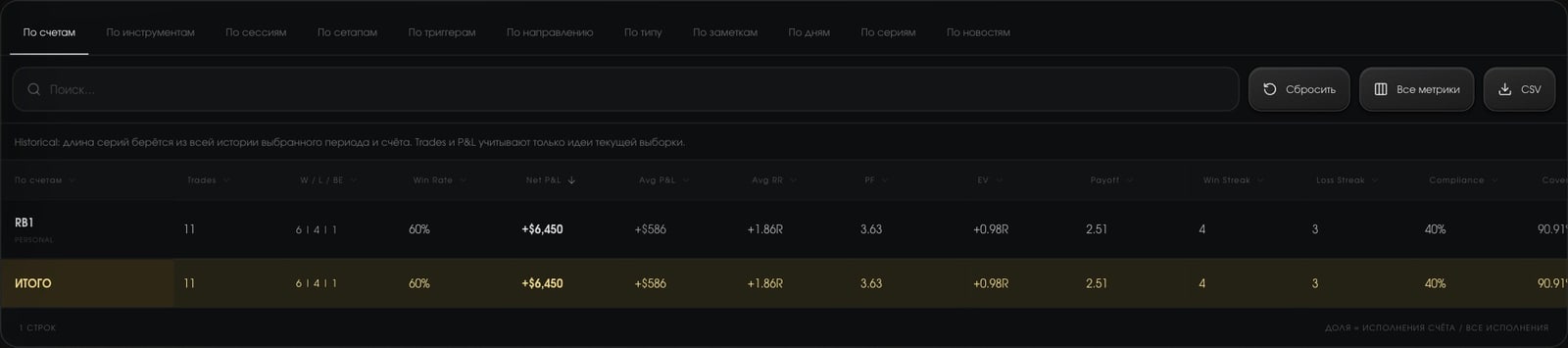
Read equal R and different money accurately
In the opening example, divide each P&L by its own known risk: $200 / $100 = +2R and $800 / $400 = +2R. The second execution contributes four times as much cash, without having a larger signed multiple in that example.
The guide to money and R separates those questions. Neither equal R nor larger money establishes equal preparation, identical conditions or better decision-making on one account.
At idea level, linked executions are combined before the normalized result is calculated. Do not add each account's R and call the sum the combined idea's R. The account breakdown and an aggregated strategy view have different observation units.
Check actual fills, costs and timing
Use available execution evidence to examine a difference. A report may show prices, volumes, costs or a different close. Identify exactly which source supports the explanation, and keep broker-reported time context clear.
Do not diagnose slippage merely from different P&L. A difference can accompany different risk, management, instrument scope or expense treatment. The journal does not automatically rank provider execution quality or verify that every order was equivalent.
Check whether costs are already included in the saved result before subtracting them again. Also distinguish an unfinished account execution from a completed one. An open position does not supply a final outcome simply because another account's member has closed.
Read the linked idea in context
Strategy views treat linked records as one idea, while the account breakdown keeps its executions separate. The idea has one set of descriptive attributes, and which member supplies them depends on the group's completed records. Different member labels do not create independent model observations.
The setup comparison guide explains the model-level scope. When members disagree, open the individual records instead of assuming every attribute always came from the original main row.
A model definition can also change during the period. Preserve which version or condition was actually available, rather than applying the newest explanation to every old account record. Missing context can limit the comparison even when cash totals are complete.
Save the numeric and contextual findings separately
A bounded note can state that the cash result differed, that known R was equal or different, and which execution evidence explains part of the gap. It can also retain an unknown cause where the source does not establish one.
A sample comparison note could say, “Risk amounts differ; both signed results are 2R. One close has a different source time. Whether that timing explains the whole cash difference remains unconfirmed.” Keep the count, accounts and dates with it.
Keep the individual values and supporting sources with the comparison. You can retain an unknown cause without ranking one account as superior, inferring a state of mind or changing all members through a common edit.