

The number 0.5 says very little about risk until you know its unit. On a $10,000 opening balance, 0.5% represents $50. A cash risk of $0.50 is a different amount. A journal needs that distinction to compare records and calculate a result relative to the money put at risk.
Santrade stores both the risk number and its mode: percentage or cash amount. Check them together when entering a trade, particularly when switching between accounts or revisiting a record whose risk was not saved at the time.
Choose the unit that matches your source
Use the percentage mode when your known risk is a percentage of the account's Day Start balance. Use the dollar mode when you have a confirmed cash amount. The choice describes the information you are recording; it does not establish an appropriate risk level for a trade.
The form does not calculate a position size from a stop price or detect the risk from an attached chart. Have a source for the number you enter. If the original risk cannot be established, preserve that uncertainty rather than choosing a convenient value to produce an attractive R result.
The difference between money and R becomes useful only when the risk behind R has a clear meaning. A precise P&L beside an assumed risk can still create a misleading comparison.
Check Day Start before converting a percentage
For percentage risk, the cash amount is the Day Start balance multiplied by the percentage and divided by 100. A positive balance is needed for that conversion. The number belongs to the particular account and date, so a balance copied from another account can change the implied risk substantially.
Suppose Day Start is $10,000 and the saved risk is 0.5%. The cash risk is $10,000 × 0.5 / 100 = $50. If the same 0.5% is recorded against $20,000, it represents $100. Equal percentages do not mean equal dollar amounts.
Read how Day Start is established when that base is missing or surprising. A conversion that depends on an unavailable positive base can remain unavailable. An unknown value should not be read as a confirmed zero.
Compare a fixed amount on two accounts
Now suppose the known cash risk is $50 on each of two accounts. Against $10,000, that is 0.5%. Against $20,000, it is 0.25%. The cash amount is equal, while its relationship to the opening balance differs.
State the unit when making the comparison. “Both trades used 0.5” could hide a mix of percentages and dollars. “Both had $50 recorded risk” is clearer, and still leaves the percentage exposure different across the accounts.
When you compare results at different risk levels, keep the chosen basis consistent. A percentage-based question and a cash-based question can both be useful, but they are not interchangeable.
Treat the unit switch as a change of meaning
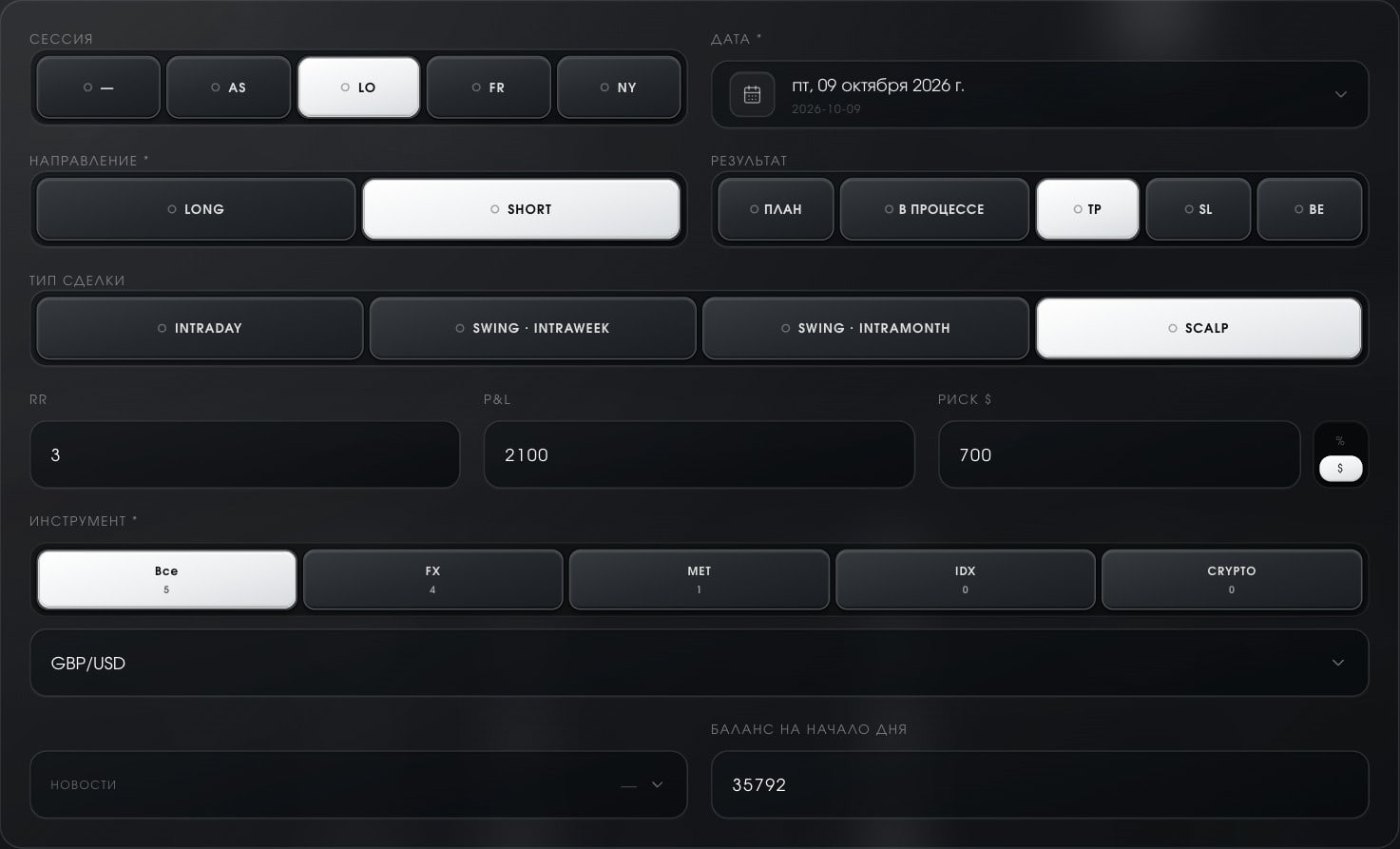
The risk switch changes the mode. It does not convert the number already entered. If the field contains 0.5 in percentage mode and you switch to dollars, the field still contains 0.5. It now means $0.50, not the $50 that 0.5% represented on a $10,000 base.
After changing the mode, enter the amount appropriate to the new unit and check the saved record. To preserve the same $50 risk in this example, the dollar field must contain 50. Reversing the switch also requires you to enter the intended percentage rather than assuming that a conversion occurred.
Before saving, read the label and number together as one quantity: “0.5 percent” or “50 dollars.” Check that both agree with your source.
Keep risk and the realized result separate
Recorded risk is the denominator used to describe the realized result. If a closed trade has P&L of +$100 and known risk of $50, its signed result is +2R. A loss of $50 on the same known risk is -1R. The dollar outcome and the risk number perform different jobs.
Average RR has its own interpretation in Santrade: it describes the magnitude of eligible realized results rather than a signed average. Use the Average RR explanation before treating that metric as a measure of profit. Recording a smaller risk after the outcome to enlarge R would change the claim the record makes about the original trade.
Reopen the entry and verify the combination
Check the account, date, Day Start, risk mode and risk number together. If the risk is cash-based, the amount itself does not require a balance conversion; expressing it as a percentage does. If risk is percentage-based, verify the positive opening balance used to derive its cash value.
Leave a short explanation where the source has a limitation. Zero risk is not a usable denominator for dividing P&L into R, and missing risk is not evidence of a risk-free trade. At the next review, check those units and the source before using the figure.