

An evening review can begin with one question about a defined trading date. Check which records belong, confirm the monetary facts and read decisions with different outcomes under the same criterion. A profitable or losing day alone does not answer how those decisions were made.
Keep the review small enough to finish. You can save one supported observation and one next task without producing a complete explanation of every market movement or every aspect of your routine.

Set the date and account scope
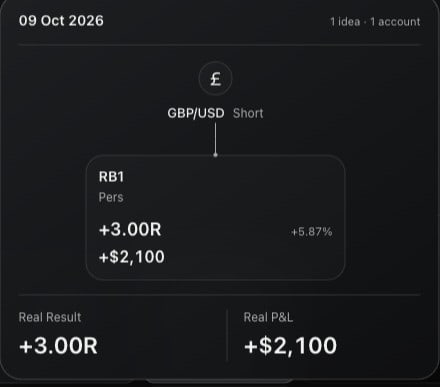
Choose the exact date and accounts. Check the controls in the Journal, Dashboard and Calendar before comparing them. A Dashboard account choice does not automatically become the same account selection in the other views.
The Journal can include plans and Processing records, while the Calendar's financial results concern completed ideas in its selected mode. A Calendar review can help locate the day's ideas and account executions, provided its month and inclusion mode match your question.
State whether you are reviewing completed decisions, all considered plans or a particular account's executions. Those samples can overlap without having the same count or financial meaning.
Confirm that the source history is current
Check whether the session's report or manual records contain the events you intend to examine. Use the history-update routine where an updated report is needed, then inspect the known results before interpreting the summary.
Partial MT5 exits and fees can have cash dates before the final closed-record date. Do not turn each cash event into an independent idea merely to make the day's counts match your memory. Read the source execution timeline where it matters.
Keep a brief list of records still waiting for source updates, separate from the day's conclusions. That prevents an unfinished import or unknown risk from silently becoming a confirmed zero in the review.
Also identify missing risk, absent context and uncertain labels. A monetary total can be known even when an R measure is unavailable. Make the gaps part of the review rather than filling them to complete the picture.
Choose the question before the most memorable trade
A sample question might be, “Which of today's management changes have a reason recorded at the time?” It names something you can check across records without requiring every change to have the same explanation.
Open ordinary entries as well as the largest profit or loss. A dramatic chart may help explain one event, but it should not decide which rule you apply to the rest. Keep the criterion stable across monetary outcomes.
The after-close routine supplies the factual notes for this step. If a record was completed only now, identify its explanation as an evening account rather than presenting it as a timely observation.
Read condition, action and evidence together
Find the saved condition relevant to the action. Compare it with the actual decision and the available image, text or execution source. A requirement added during this review is a future proposal, not an old rule the trade is claimed to have followed or broken.
A sample finding could say, “One management change has a timely explanation; another has execution evidence but no saved reason. The second reason remains unknown.” Keep that distinction whether or not either case has a process assessment.
Personal observations belong with their timing. A later recollection of urgency can be preserved as a recollection. The day's money result does not establish that urgency caused every decision or that an unlabelled entry had the same state.
Keep the financial units and counts clear
Read P&L as money, signed R as relative to known risk and Average RR as an unsigned magnitude measure. Do not add the R values of several executions of one idea and call that the idea's combined R.
For a shared idea, expand the member accounts where money or risk differs. Preserve the common decision context without converting each account row into another independent example of a behaviour.
If you use Notes assessments, read Coverage with Compliance and leave unassessed cases visible. A fully compliant evaluated portion can coexist with records whose earlier conditions were never saved. The assessment does not automatically extend to those gaps.
Save a short conclusion and next task
Record the date, accounts, question, supporting records and unresolved cases in your review material. A useful next task addresses the gap you found: save a management reason when it occurs, preserve an earlier condition or verify a particular source value.
Take a recurring question into the weekly review instead of retelling the day in every trade comment. Save the day's monetary facts and the supported process finding. Neither supplies a judgement about you, a complete causal explanation or a forecast for tomorrow.