

Take a record you expected to understand and try reviewing it from the saved material. Can you identify the event, follow the decision and locate the evidence? This is one way to check whether the journal supports the review you intended to do.
Choose these checks for your own process. Santrade does not assign a universal journal-usefulness score or infer improved discipline from your visits. Assess what you can now examine in the saved records.
Find a record without relying on the memory of it
Choose a known date, account or setup and locate a suitable entry. Check whether your labels make the event identifiable. If you find three nearly identical names for the same idea, note the naming problem before trying to interpret their separate groups.
Try another record whose outcome is less memorable. A journal should support ordinary cases as well as the examples that first come to mind. The search path itself can show where your organization needs clarification.
Use records with missing details as a practical work list. Missing labels reveal a gap in the available material; their presence does not automatically rate the underlying trade.
Read the saved decision context
Read the plan, action comment and available chart captions. Establish which information was recorded before the decision and which was added during later review. A current edited description does not by itself preserve every earlier version of the plan.
Check whether you can find a saved cancellation condition and compare it with the action. If you can, your record supports a question that the cash result alone cannot answer. If you cannot, name the missing evidence rather than complete the explanation from the final chart.
You may discover that the first pass needs one more sentence or a differently chosen image. That is a specific change to the recording method, which you can check on later entries.
Inspect the coverage of rule assessments
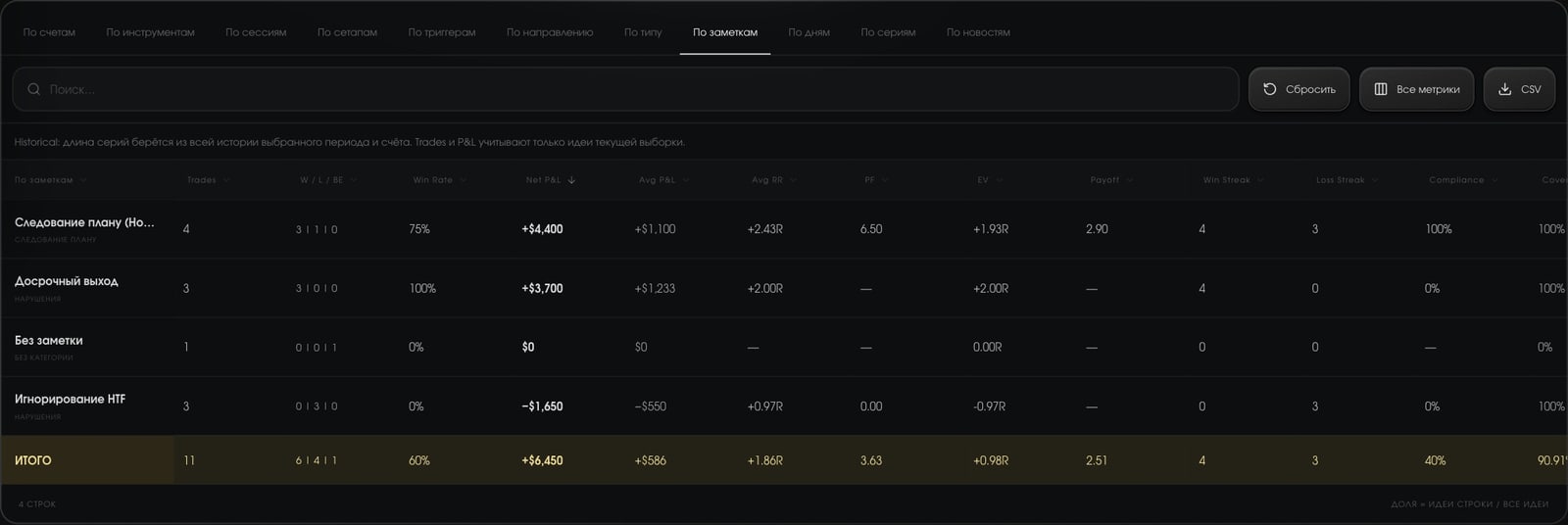
Notes categories can classify a linked observation as compliant, a violation or unrated. Rule Compliance summarizes assessed closed ideas. Coverage shows how much of the closed sample has been assessed, so the two figures need to be read together.
Suppose ten independent closed ideas include four compliant, two violations and four unrated. Compliance is 4 / 6, about 66.7%; Coverage is 6 / 10, or 60%. The unassessed four are not silently treated as compliant.
The Rule Compliance guide explains the category semantics and priority rules. Changing labels on old records can change the displayed history without any new trading action. An increase in coverage describes that assessment work first.
Name a question that is now answerable
Look back at the reason you began keeping the journal. Perhaps you can now distinguish two versions of a model, find recorded early exits or identify which sessions still need context. State the question and point to the records that let you examine it.
You could note: "I can now find the cases linked to rule A and compare their written plans. Earlier records still lack an image showing the moment of the decision." Check whether the material you actually saved supports a similarly specific observation.
Keep financial changes separate from this assessment. A higher P&L can prompt another question, but the difference alone does not isolate journaling as its cause. The quality of your saved explanation can be checked directly.
Improve one part of the procedure
Choose an action that addresses the specific gap: standardize a setup name, add the event that cancels the plan, or save an image with a clear time context. Write what will count as completing that action.
The process for turning observations into rules can help you make the wording usable. Keep it as a personal procedure with a date, rather than presenting a single favorable outcome as a general market rule.
Avoid changing every part of your record at once if that makes the next check unclear. A bounded change lets you inspect whether the intended information was actually retained, even while trading conditions and cash results continue to vary.
Repeat the check on a comparable set
At a later weekly review, use the same question and identify the records you checked. Note whether the new procedure was followed and where the original gap remains. You can also record what took unnecessary work and simplify that part.
Keep the old review's dates and definitions. If a later figure changes because you corrected an import or reassigned Notes categories, preserve that explanation. Changes to the data and changes to behavior are different events to investigate.