

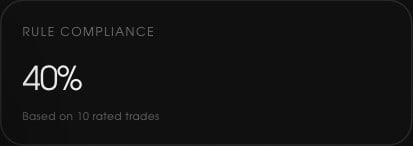
Read Rule Compliance alongside Coverage. Compliance describes adherence among assessed closed ideas; Coverage shows how much of the closed history has been assessed. Without the second figure, a small documented portion can appear to represent every decision.
Both figures depend on the Notes categories you maintain. Santrade calculates the result of those assessments; it does not watch the original decision and determine whether your personal rule was followed.
Build the assessed denominator
A closed idea can be compliant, a violation or unrated according to its linked Notes categories. Rule Compliance is the compliant count divided by compliant plus violation counts, multiplied by 100. Neutral observations and unrated ideas do not enter that denominator.
TP, SL and BE are closed outcomes for this purpose. PLAN and Processing are outside the closed sample. The monetary sign does not assign the assessment: a profitable idea can contain a supported violation, while a losing idea can have supported adherence.
The individual reviews of a profitable rule violation and a loss that followed the plan show why the assessment and financial result need separate evidence.
Put Coverage beside the result
Coverage is the assessed count divided by all included closed ideas, multiplied by 100. It keeps the unrated portion visible even though that portion is excluded from the Compliance denominator.
Suppose ten closed ideas contain six compliant assessments, two violations and two unrated cases. Compliance is 6 / (6 + 2) × 100 = 75%. Coverage is 8 / 10 × 100 = 80%. The first percentage describes eight assessed ideas, not all ten.
Write down why cases remain unrated, such as a missing original plan or unconfirmed action. That makes a later increase in Coverage traceable to new evidence rather than a guess made to complete the table.
If there are no assessed closed ideas, there is no adherence denominator to interpret. If there are no closed ideas, there is no closed-sample Coverage to interpret. Check the counts before reading an unavailable value as a confirmed zero or as poor conduct.
Understand what a reassessment changes
Now suppose a reliable source allows one of the two unrated cases to be assessed as a violation. The same ten closed ideas now contain six compliant, three violations and one unrated case. Coverage rises to 90%, while Compliance becomes about 66.67%.
The classification changed without a new trade or monetary change. A lower percentage can accompany a more fully assessed record, even though no new decision was made.
Keep corrections and category changes in your review notes when comparing saved summaries. Otherwise an updated classification can be mistaken for a change in the trading procedure itself.
Check category meaning and priority
The analytical type of the Notes category determines its role. A title or colour does not make a card compliant or a violation. Use the Notes classification guide to choose that meaning deliberately.
When linked categories include both compliant and violation types, violation has priority for the overall assessment. Neutral cards do not cancel a violation. A comment can still explain which actions followed the plan and which departed from it.
Changing a category can affect the meaning of its existing links. Review several attached cases before using a shared category for a different purpose. A category edit is more than changing the wording beside one isolated trade.
Keep the rule and observation unit traceable
A supported assessment needs a condition that existed before the action and evidence of what happened. An empty Notes field is not compliance by default. Where the earlier plan or action cannot be established, leave the idea unrated rather than guessing.
Linked account executions are combined at idea level in the main strategy metrics. A compliant label on one member and a violation on another can produce one idea assessed as a violation. The count is not an average vote across independent decisions.
A single-account scope can represent that account's execution instead. Preserve the account and date scope when comparing the percentages, and inspect the member records when their assessments differ.
Save a bounded process finding
Retain the period, accounts, closed count, assessed count and unresolved cases. A useful note can state that the assessed portion has a particular adherence rate while a defined part of the history remains unknown.
Use the review of violation-group results to examine the money separately. High Compliance does not establish profit, and positive violation-group P&L does not establish that the deviation helped. Keep the underlying definitions, records and assessment coverage with any comparison.