

The P&L of trades marked as violations describes the money recorded in that selected assessed group. A positive total does not establish that breaking the rule helped. A negative total does not calculate what would have happened if every action had followed the plan.
Check the assessment basis and selection before reading the count, money and risk measures. Open the actions behind those measures and state the finding in terms of the selected history.
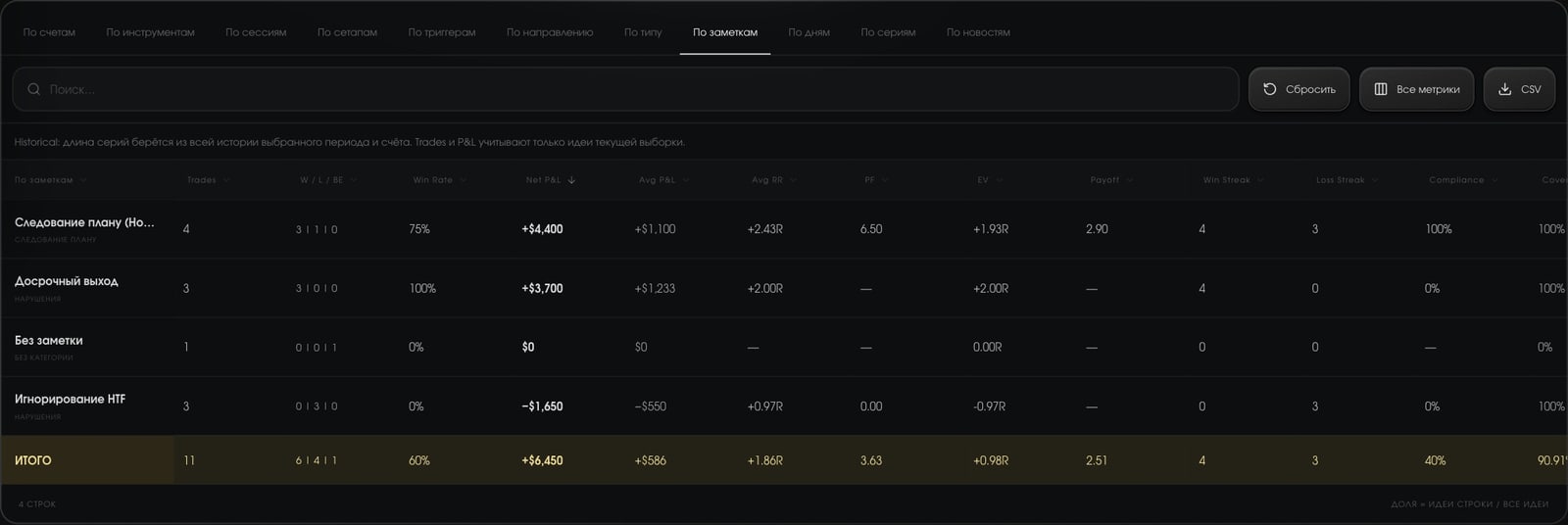
Check what made the cases violations
Open the linked Notes definitions and category types. Confirm the earlier requirement and the evidence of the departure in a few underlying records. A label named Error or a particular colour does not assign violation meaning by itself.
The reviews of a profitable violation and a losing compliant trade show why process assessment is independent of monetary sign. Keep both findings where both are supported.
A rule created during review cannot become the requirement the earlier trade is claimed to have broken. Where the condition or action is unknown, preserve that gap rather than making the assessed sample appear complete.
Choose the period, accounts and precise filter
In the Journal, the Notes filter can select an overall violation status. In Deep Analytics, you can select particular Notes or categories and inspect the corresponding closed metrics. Read which kind of selection you used.
A category filter selects that category's presence. A compliant card can coexist with a violation card, and violation has priority in the final overall classification. Category presence and final assessment are therefore not always identical filters.
The Notes classification guide explains the shared category meaning. Save the exact period, account scope and selection in your review so that you can return to the same history later.
Retain the assessed and unknown portions
Read the number of included closed ideas and the amount of history that remains unassessed. The Compliance and Coverage guide separates adherence among evaluated cases from how much of the closed sample has an evaluation.
If violations were labelled mainly after large losses, the selected group has uneven documentation. Its P&L is still a result of those records, but it cannot automatically describe every rule departure in the history.
The same issue applies when definitions changed or a category was reassigned. An older summary may differ after a labelling correction even without a new execution. Keep the data change visible before attributing a difference to better conduct.
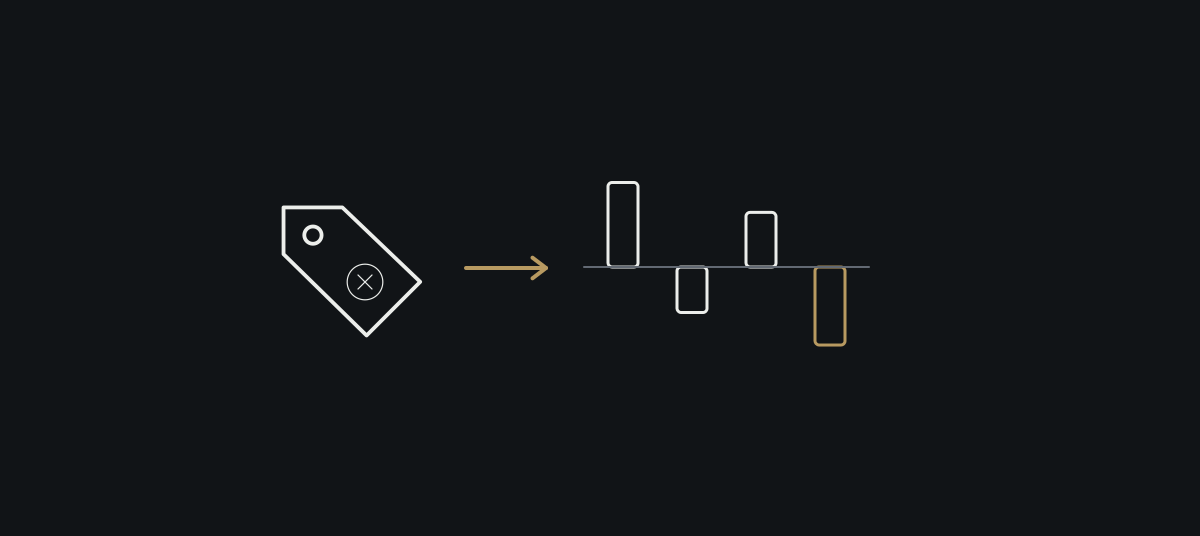
Read cash and risk measures by their definitions
Inspect actual P&L, the largest contributions and known risk inputs. Average RR is unsigned and excludes BE; Expected Value needs signed R for the complete included closed sample. A cash total can remain known while an R-based measure is unavailable.
Check the unit of aggregation. Strategy dimensions represent linked account executions as one idea, while an account-level view can preserve separate executions. Several members of a shared decision should not silently become several independent demonstrations of a behaviour.
If you place a compliant group beside it, check whether the two contain different instruments, models or risk amounts. They are selected histories, not the same trades executed once with and once without the departure.
A large positive or negative record can dominate the group. Open it and inspect the condition, action, risk unit and account base before using the summary to explain a recurring pattern.
Do not add overlapping Notes rows
One idea can link to several cards and appear in more than one Notes row. Suppose a +$100 idea carries two violation cards. Each card's row can show +$100, but the represented total remains +$100, not +$200.
The overlap also affects counts and shares. Check the table's scope and footer for the distinct represented total, rather than summing Notes rows as though each label were another event.
Likewise, a shared definition does not mean every linked event had identical circumstances. The trade descriptions supply the particular condition and action. Use them when examining whether a few large outcomes conceal different kinds of departures.
State what the group result can support
A useful finding names the selected assessed group, dates, accounts, idea count, money result and documentation limits. It can then identify a narrower question, such as which required step was repeatedly skipped or which records need a source check.
Keep alternative entry or management results outside actual P&L. The app does not calculate a causal cost of violations or the profit that would have existed without them. Describe the selected records and their actions while leaving that unobserved alternative unresolved.