

A library of recurring mistakes works best when its entries describe actions you can recognize. “Poor discipline” leaves a large interpretation gap. “Entered before the required preparation was complete” gives you a condition, an action and a reason to inspect the evidence.
Start with one supported pattern from your records. Build a reusable definition around it, then link cases using the same standard. The library can remain small while its entries become easier to understand and apply.
Name an observable action
Find a record with a known earlier requirement and a supported departure. Describe the step in plain language. Avoid defining the card through the monetary result, since a similar action can occur in profitable and losing trades.
A sample title could be “Required check skipped before entry.” Define what counts as evidence and what remains uncertain when the original condition is missing. The wording should let you recognize the same action in another record.
Use the review language guide when a broad judgement hides the event. A precise action name allows a later review to disagree with an assessment or identify an unknown case without judging the whole person.
Create the shared Notes definition
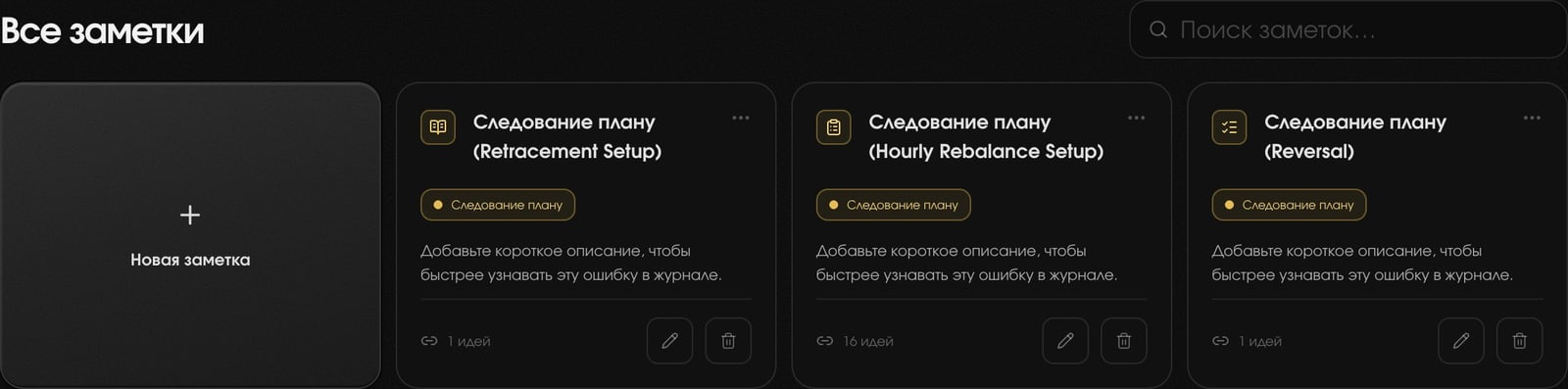
Notes cards support a title, description, icon and category. The description can hold up to 5,000 characters, while shorter displays show an initial portion. Put the essential definition early so that the card is recognizable before opening its full text.
Explain what the observation requires, what it does not establish and which source should be checked. For example, distinguish a timely statement confirming a skipped step from an empty comment that merely lacks documentation.
Choose the category's assessment type deliberately. The classification guide explains why the card name or colour alone does not make it a violation. A neutral recurring observation can be useful without being a rule assessment.
Keep each event in its own trade record
Attach the card only where the definition is supported. A trade can have up to four Notes, so choose labels that add meaningful information rather than filling the available space. Several labels do not supply several independent examples of the same event.
Use the trade comment for the condition, actual action, timely image and unresolved question in this case. The Notes description is shared across its links. Editing it changes the definition readers will see for other attached records too.
A sample comment could say, “The required final check was incomplete at entry; the entry image and timely text support this. The reusable card describes the pattern; this comment identifies the missing step.”
Apply the standard across different outcomes
Look for supported cases on both monetary sides, including ordinary small outcomes. Do not attach the label only to memorable losses or remove it when the action happened to make money. The shared definition should survive a change of P&L sign.
Keep uncertain cases distinguishable. A missing earlier plan cannot be completed by choosing the most plausible error label. You can preserve an open review question without assigning a supported violation.
For linked account executions, inspect the common idea and individual circumstances. Notes usage counts an idea once for a card, even when several account members carry the same link. An account-specific action needs its account identified in the event's text.
Read recurrence with its period and coverage
The Notes view provides usage counts, shares and instrument distribution for its selected period. Its usage can include plans and open records as well as completed ideas. It is not the same denominator as closed financial performance or Rule Compliance.
A higher usage count can reflect more recorded cases, more complete labelling or a revised definition. It is not automatically proof that the behaviour became more frequent. Retain the selected period and the unlabelled or unassessed area when writing a comparison.
If a card appears rarely, inspect whether the definition is too narrow, unclear or simply uncommon in the available history. The source records can support a limited finding without requiring a large library or a progress score.
Refine the library without rewriting its history
Before changing a shared definition or category, read several existing links. Preserve the reason for a material change in your own review notes. A revised meaning can alter how old cases are interpreted even when no new trade occurred.
Keep longer explanations, sources and model documents in a broader knowledge base. Use the Notes library to find recurring observations beside actual cases. Each event record should explain why its link belongs or what remains uncertain.