

Replace “I always ruin trades” with the action the record supports. If a required check was skipped, name the check and the evidence. If the earlier condition is missing, state that limit. A concrete account gives the next review something to examine without turning one event into a verdict about you.
You can state a known departure directly. Keep the wording specific enough to check against the record, without requiring a positive interpretation of the mistake.

Rewrite the judgement as an event
A sample revision could be, “The plan required the preparation checklist before entry. I entered with its final item incomplete. The timely comment and entry image support that sequence.” It names the condition, action and source rather than a personal trait.
If the evidence is weaker, narrow the statement: “No preparation image was saved; I cannot establish the checklist state from this record.” That is a different finding from confirming the step was skipped. Clear language should preserve the distinction rather than hide uncertainty.
The trade-comment guide helps keep the account short. You need enough detail to identify the event, not a long explanation of every movement on the chart or every thought you might have had.
Check the rule before assigning a breach
Find the condition that existed before the action. Include permitted exceptions and the relevant account context. A new rule written during the review can guide future records, but it cannot establish what the earlier action was required to follow.
Where the earlier plan was overwritten or never saved, preserve that gap. A completed chart can support a new question without reconstructing an old intention. The absence of a complete explanation does not require an immediate compliant or violation label.
A useful review can assess one supported stage while leaving another open. For example, entry preparation may be documented while a later management choice is not. State the scope rather than claiming a complete verdict on the whole trade.
Preserve the money without making it the explanation
Keep the actual result, P&L and original risk basis. A profit does not cancel a known breach, and a loss does not automatically establish one. The review of a profitable violation explains one combination; the review of a loss following the plan explains the other.
Do not replace the real outcome with the money you imagine a better action would have made. A later favourable point on the chart is not a guaranteed execution. It can motivate a separate question while the financial history stays factual.
The same care applies to R. Choosing a different risk after the result to make the ratio look better would change the recorded basis, not clarify the action under review.
Record your observation as your observation
You can write that you felt hurried, frustrated or reluctant, if that is what you personally noticed. Identify when the sentence was written. A timely observation and a later recollection have different roles in explaining the available record.
A sample line could say, “Evening review: I remember wanting to finish quickly; I did not record that thought before the entry.” It preserves the account without presenting the recollection as an established cause of the outcome.
Santrade provides descriptions, image captions and reusable Notes for these records. It does not diagnose a state from a loss. Keep the action and its evidence at the centre of the assessment.
Give a recurring action a usable name
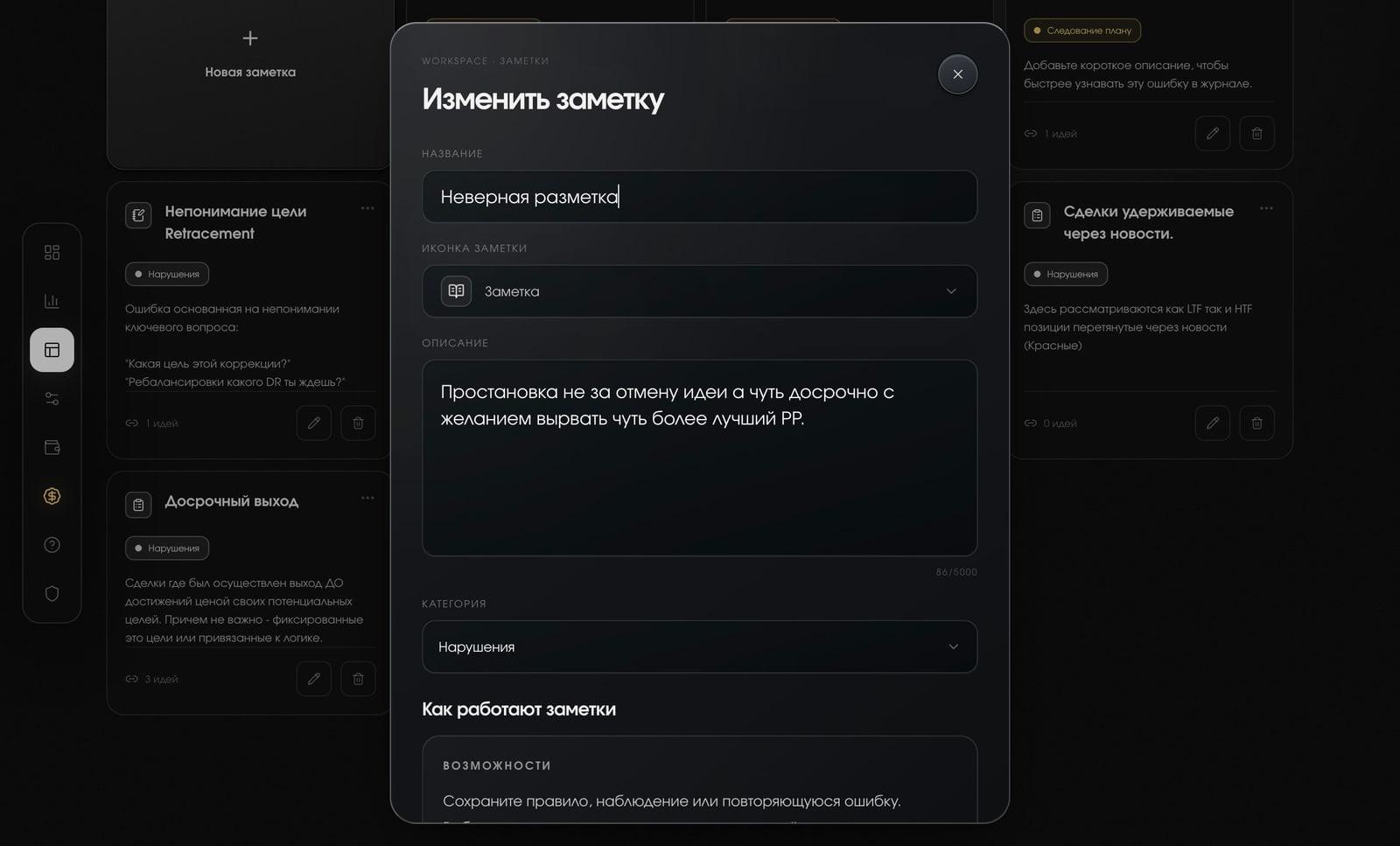
If several supported cases share the pattern, create a clear definition in a recurring-mistake library. One card can describe the observable condition and evidence needed to attach it.
Keep each event's circumstances in its own trade description. A Notes card has common text across its links, so a private narrative about this entry should not be made to describe every other case. Choose the category's assessment type deliberately rather than relying on its title.
Include varied monetary outcomes and uncertain cases in the broader review. A label attached only after memorable losses will have different coverage from a consistently applied definition. Preserve that limitation beside any claim about recurrence.
End with a recording step you can recognize
Choose a task that addresses the actual gap: save the original condition, capture the relevant view or add a short timely explanation when management changes. State what would show that the recording task was completed.
This is a practical review method, not therapy or a promise to eliminate self-criticism. A direct assessment can remain alongside the actual financial result and any unresolved question. Use the next record to preserve the evidence missing here.