

“Bad discipline” gives you a judgement with little to check. “Entered before the final checklist item was complete” names an action you can compare with a condition. Write the comment so you can examine that decision when you return to the record.
Write for the reader who will open the record later, including your future self. That reader needs to know what happened, what evidence remains and which part is still a question. A short, specific account is often enough.

Start from the question you expect to revisit
Decide what the comment needs to explain. It may be an entry taken before a condition, a change in management, or a difference between the intended and actual close. Keep the explanation close to that question rather than narrating every movement on the chart.
If you are comparing plan and execution, preserve the condition you had actually saved. Then describe the action. If there is no earlier plan to consult, say that the original condition was not recorded. The comment can still document the execution without supplying an invented earlier intention.
This approach also helps with older trades. A later review may establish a few facts and leave the motive uncertain. Identifying that limit is more useful than writing a confident explanation simply because the monetary outcome is now visible.
Distinguish an action from your interpretation
A report or saved image can support an observable event. Your own timely text can record what you were thinking. A later interpretation belongs in the review as an interpretation, with enough context to show when you formed it.
For example, a sample comment might read: “Plan required the checklist before entry. I entered while the final item was still pending. The entry image shows the incomplete list. Evening review: I remember wanting to avoid missing the move. Next question: when did I stop checking the list?”
Use this structure in the existing text field. It does not create extra native fields or an automatic assessment.
Use the description for this event
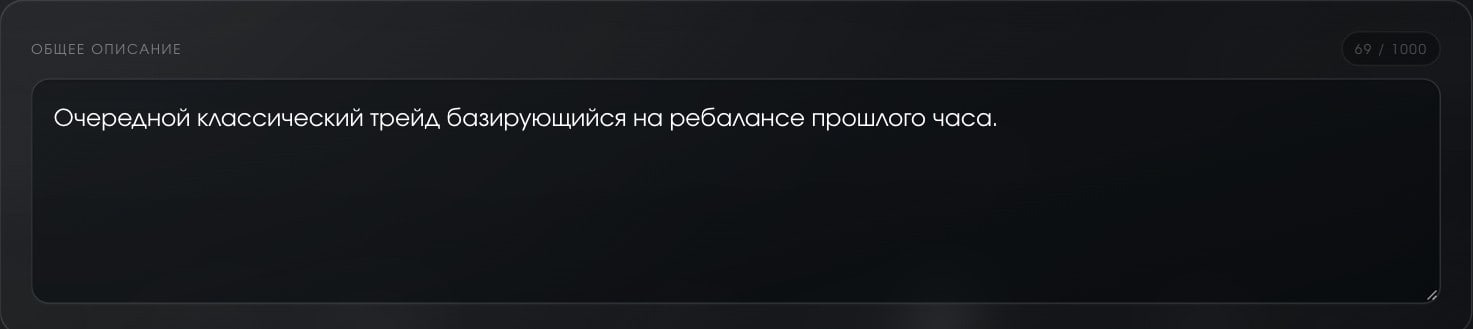
The general trade description allows up to 1,000 characters. Use it for the circumstances, the key decision and a question. Remove repeated background that is already clear from the saved fields.
Short labels such as “At entry” and “After close” can distinguish a timely note from a later addition. Preserve the original wording where it matters before replacing it. The editor updates the current description rather than providing a readable archive of every earlier version.
For a linked multi-account idea, check the editing scope. A description changed through the main record can be shared across executions. A sentence about one account's circumstances should identify that account clearly rather than appearing to describe every execution in the group.
Give image-specific detail its own place
Each attached chart has a separate description of up to 1,000 characters. Put the explanation of that view there: when it was captured, which detail matters and whether the annotations were added later. Use the general comment to connect the decision rather than repeating every caption.
A chart can reduce the amount of prose needed, but it still needs a clear purpose. “Image taken after the exit; arrows added during review” tells the reader how to interpret the marks. The guide to trade-review screenshots explains how to choose images around a question.
If the evidence is missing, a brief statement of that gap is useful. “No image saved at entry” gives a more accurate account than implying that a later annotated chart reproduces everything you saw then.
Keep reusable Notes definitions separate
Santrade's Notes cards are reusable. Their description can contain up to 5,000 characters, and a trade can link up to four Notes. The text of a card is common to its links, so it is the place for a shared definition or recurring observation, not a different private narrative for every attached trade.
For a library of recurring mistakes, a card might define what counts as entering before a required condition. The trade comment can then explain the particular condition and action in this record. Changing the card's definition affects how its meaning is read elsewhere, so keep that distinction deliberate.
A linked label should make the comment easier to interpret. It does not remove the need for evidence, and it should not turn an uncertain recollection into a confirmed rule violation.
Read the comment once without the P&L
Ask whether the comment still makes sense when you set the monetary outcome aside. Can you identify the action? Can you tell which claim has support? Is the final question specific enough to investigate? Replace broad self-labels with the event you can actually describe.
A loss alone cannot tell you that fear caused an entry, and a profit does not confirm careful execution. Keep the review focused on recorded actions and your own observations. The method for reviewing mistakes without self-blame builds on the same concrete language: explain the event in terms you can use again.