

A trade can finish with a clear monetary result and an unclear account of the decisions behind it. “Good entry, poor exit” is hard to examine a week later. A useful comparison starts with something more specific: the condition you had saved, the action you took and the evidence that connects them.
Santrade gives you a general description, charts with their own descriptions, setup and entry-reason labels, and linked Notes. You can use those fields to make the comparison explicit. There are no separate native planned-versus-actual columns that perform it for you.

Start with the plan you actually preserved
Find the wording or image available before the decision. Read it without adding the explanation you now prefer. Was the entry conditional on a completed checklist? Did the plan describe what would justify a management change? Was an exit condition recorded at all?
If the original statement is vague, preserve that limitation. “Wait for a good opportunity” leaves more room for interpretation than a named condition you can check. Where the earlier plan was overwritten or never saved, mark the original intention as unknown. The finished chart cannot recover your earlier thoughts.
The distinction between plans, open positions and closed trades helps here: a record saved as a plan can hold the context, but later edits still need careful labelling to keep that context readable.
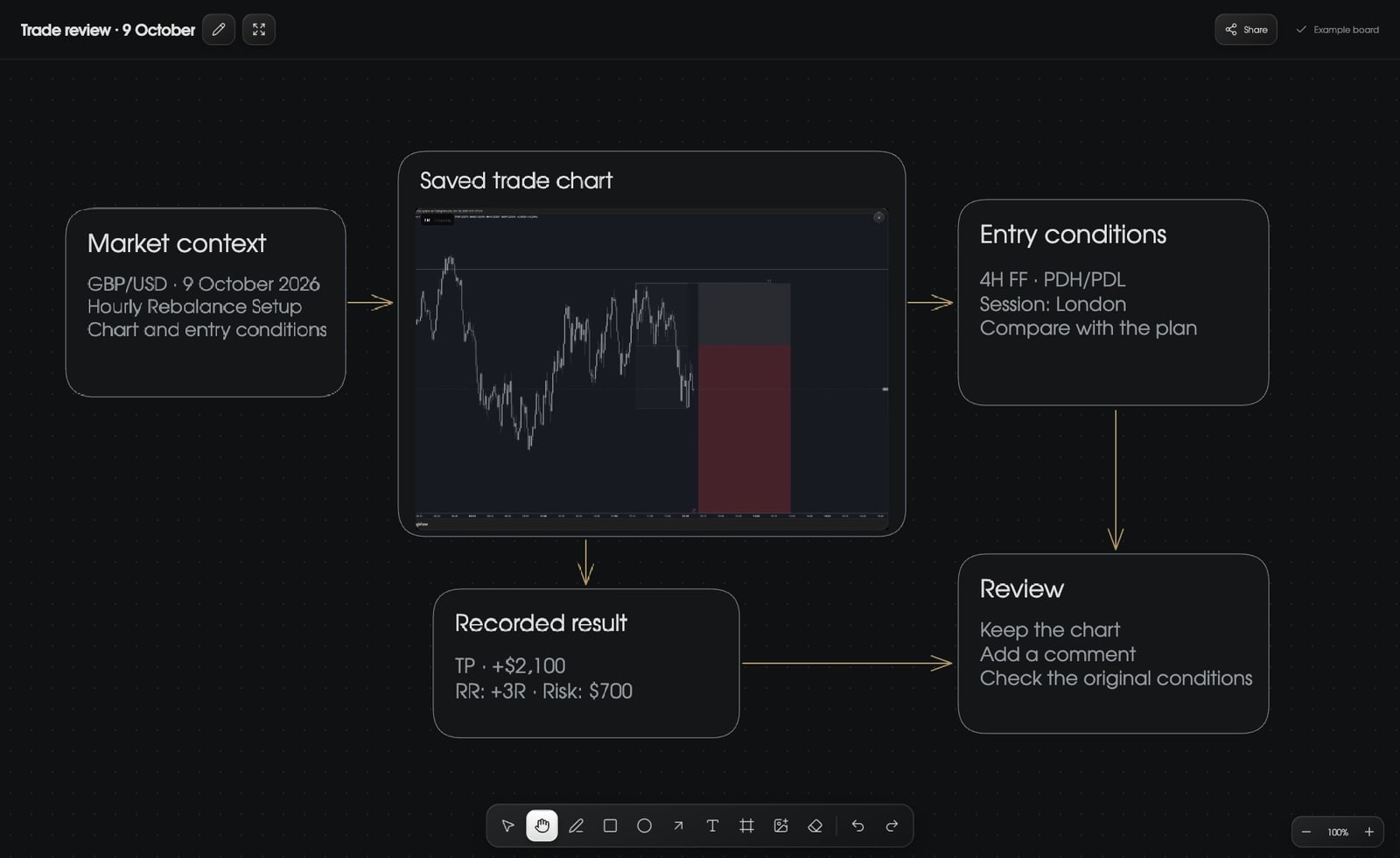
Reconstruct actions in their actual order
Describe the entry, relevant management decisions and exit using sources you still have. A report can establish an execution. A timely chart can show the context visible then. A comment written later can explain your recollection, provided you identify it as a later account.
A sample comment could read: “Plan required the checklist before entry. Entry was placed while the final item was still unchecked. The screenshot taken at entry shows the same incomplete item.”
If you can confirm only the entry, assess that step and leave management or exit open. State the remaining gap so you can see which part still needs evidence.
Compare one decision at a time
For each stage, ask what the saved condition required and what the available evidence shows. An entry may match its condition while a later exit departs from the management plan. One overall label can hide that difference unless the comment explains it.
- Entry: which recorded conditions were present when you acted?
- Management: what action occurred, and was its basis written in advance?
- Exit: what closed the position, and how does that relate to the saved condition?
These questions are a review structure you can write yourself. They do not require a prescribed trading method. Your own rules determine what counts as an allowed action, and the record determines how confidently you can assess it.
Use images to answer a specific disagreement
A chart is most useful when it clarifies a disputed detail: the information visible at entry, the state of a checklist, or the point when management changed. Add a caption explaining the question it answers. Choose screenshots for the review rather than collecting images only because the finished move looks tidy.
Separate a chart captured at the time from an annotated image created after the close. Both can help, but they support different claims. A later annotation can explain a review; it cannot establish that the marked condition was part of the original plan.
Keep process assessment separate from the outcome
A profit and a loss describe money. Following a rule and departing from it describe conduct relative to a known condition. Where you use Notes categories for compliance assessment, make the category agree with the evidence you have recorded.
For example, an entry taken before a required checklist was complete remains a departure from that requirement even if the trade makes money. Conversely, a loss alone does not show that the entry broke a rule. An unknown condition deserves an unknown assessment until there is enough information to decide.
Your trade comment can hold the circumstances of this particular execution. A reusable Notes card can define the recurring behaviour so that the same term means the same thing across records.
Choose one improvement to the next record
Choose a recording change that addresses the uncertainty you found. The next plan might need a more precise exit condition. You might need a chart before changing how you manage the position, or a short update when you depart from an earlier intention.
This keeps the comparison connected to information you can collect. When the whole review rests on how obvious the completed move now looks, return to the information available at the time. The next record should make that earlier view easier to reconstruct.