

A trade can make money while departing from a rule you had already written. Record the positive P&L in the financial history and the supported departure in the process review. Changing either to make the two agree would remove useful information.
Begin with the rule and the action, not with a verdict about the trader. A profitable outcome gives you a result to record; it does not establish which conditions were followed before entry or during management.

Find the rule that existed beforehand
Open the saved plan, checklist or model material. Identify the specific condition relevant to the action. “Be disciplined” is difficult to assess; “complete the preparation checklist before entry” names a sequence you may be able to verify.
Check that the condition was part of the earlier plan. A new rule invented during the review cannot be treated as a requirement the original trade broke. You can save it as a candidate for future use, with its later origin clearly stated.
If the earlier wording is missing, leave that limitation visible. A completed chart and a preferred explanation cannot reconstruct an overwritten plan or establish what you intended at the time.
Establish the action and its evidence
Suppose the saved rule required the checklist to be complete before entry. An image captured at entry shows an unfinished item, and a timely comment confirms that the entry was placed before completion. The factual departure is the order of those actions.
A sample comment could read, “Checklist-before-entry rule was saved. Entry occurred with the final item incomplete. Entry image supports this. Closed P&L was +$100.” The positive result does not cancel the recorded sequence.
Separate what is supported from what is recalled later. If you remember wanting to enter quickly but did not record that thought, identify it as a recollection. You do not need to establish a motive to describe a confirmed action.
Preserve the actual financial result
Keep the correct result label and monetary amount. A rule violation should not be recorded as a fabricated loss, just as a compliant losing trade should not be turned into a profit. Financial measures and process assessments describe different parts of the history.
The paired review of a losing trade that followed its rules shows the other combination. Both cases can remain useful without treating a single result as proof that the underlying model or rule is effective.
Also preserve the original risk basis. Rewriting the risk after the result to produce a preferred R value would change another part of the account you are trying to examine.
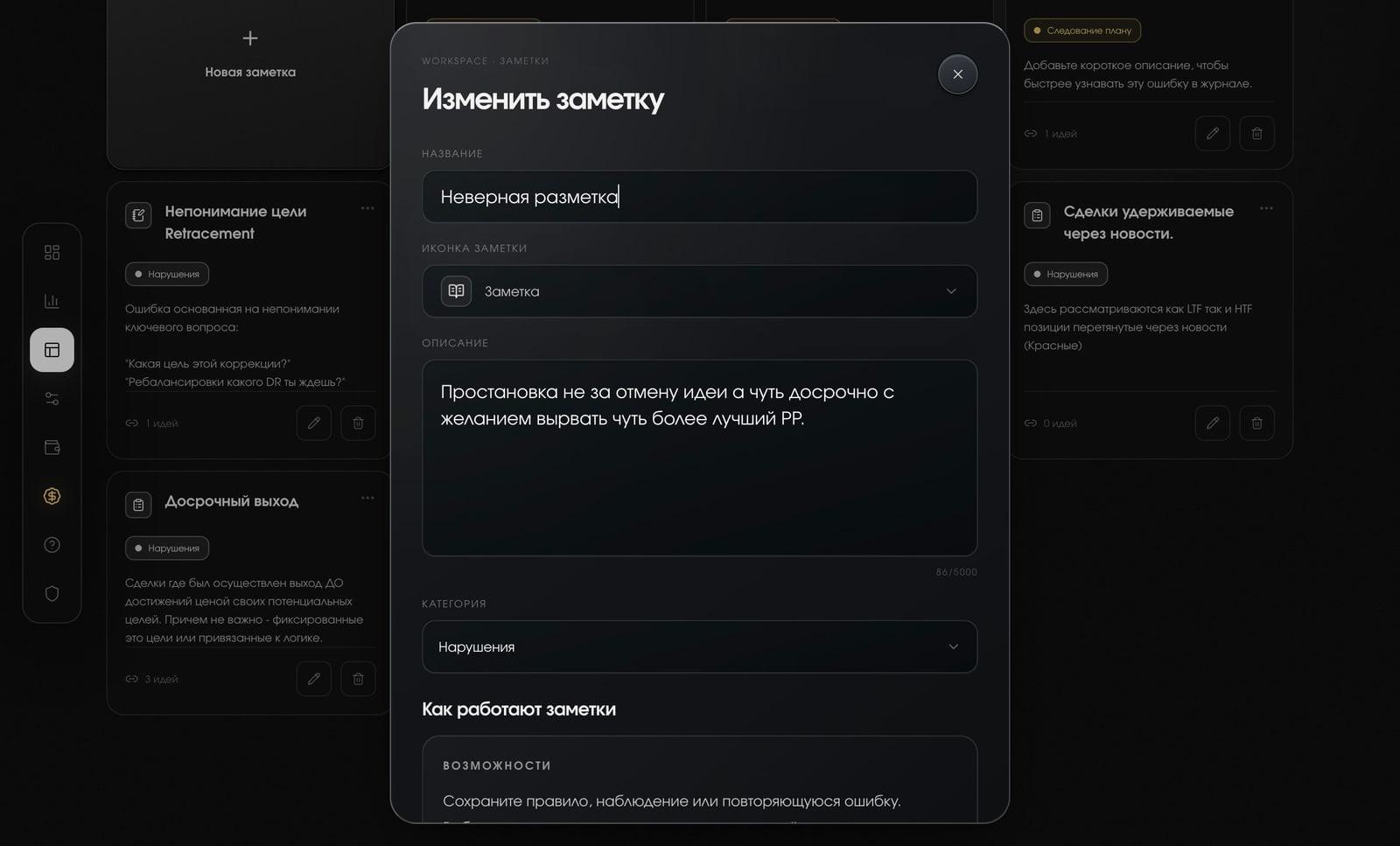
Choose a Notes category deliberately
A reusable Notes card can describe the type of departure, while the trade comment retains this event's condition and evidence. The card's category has an analytical type; its name or colour alone does not establish the assessment.
The guide to classifying Notes distinguishes observations, compliance and violations. A neutral observation about confidence is different from a supported breach of a defined requirement. Choose the assessment that matches what you can establish.
Where linked cards include both compliant and violation types, violation has priority in the calculation. That is a product classification rule, not an automatic judgement about every action in the trade. The comment can explain which step followed the plan and which did not.
Read the assessment with its coverage
Rule Compliance uses evaluated closed ideas, and Coverage shows how much of the closed history was evaluated. A profitable record with a known violation belongs to that assessed history without changing its positive monetary contribution.
Do not treat an empty Notes field as compliant by default. If several older records lack the earlier conditions needed for assessment, preserve the unrated portion when comparing groups. The well-documented cases do not silently speak for all others.
For a linked multi-account idea, check the common context and the individual executions. A shared note can describe the idea, but an account-specific circumstance should be identified clearly in the event's text.
Finish with one useful recording change
Ask what would make the next comparison easier. You might save the checklist state before entry, preserve the exact management condition or add a short timely explanation when departing from it. Keep the task close to the gap you found.
Use specific language when reviewing mistakes: condition, action, evidence and next question. Keep the profit in the record while explaining the departure in terms you can check when you return to the entry.