

A streak length and a selected trade count can differ without a calculation error. In Historical mode, the length can describe a run in the broader period and account history while the row's money and Trades count describe only its selected members.
Filtered mode constructs a different sequence by applying the relevant attributes first. Read the mode, scope and counts together before comparing two streak reports.
Begin with the closed sequence rules
Santrade orders closed records by their saved date and ID. TP extends or begins a winning run; SL extends or begins a losing run. BE is skipped without breaking the run. PLAN and Processing do not supply closed outcomes.
Saved date and ID define the calculation's order, without reconstructing exact intraday decision timing or showing which result you had seen before another entry. The manual review after wins and losses needs separate evidence for that question.
Account and period boundaries also matter. A Historical sequence is historical within the chosen scope. It does not silently bring in results from earlier dates outside the period or from a different selected account.
Read Historical as the surrounding context
Historical keeps the selected period and account sequence before applying the other strategy attributes. You can then inspect a setup or another subset while retaining its members' place in the surrounding runs.
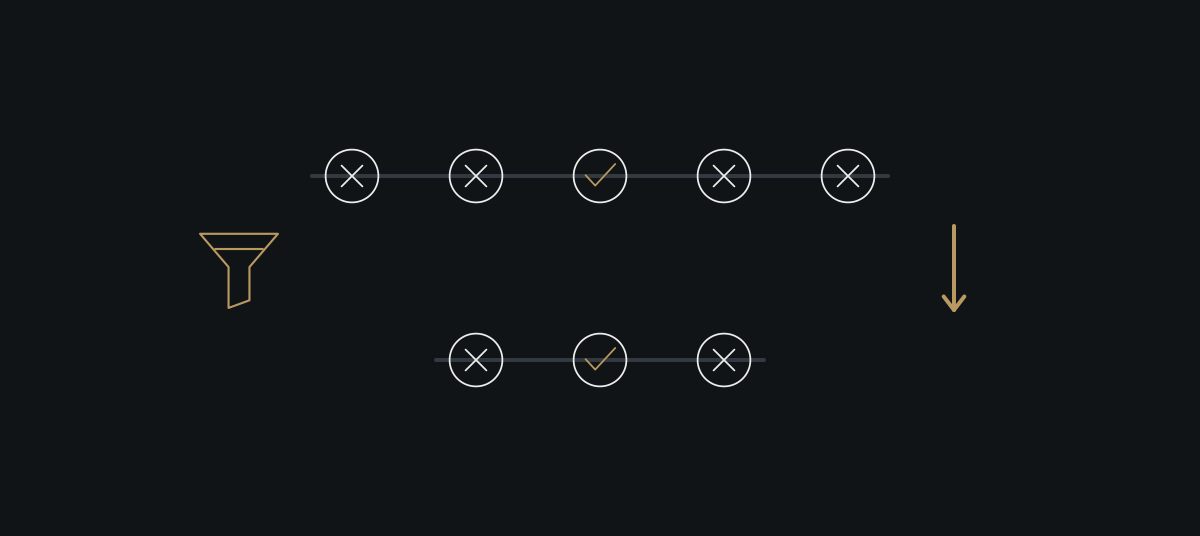
Suppose five consecutive SL ideas belong to that scope. Only the second and fourth carry the setup you select. The selected setup contributes two ideas, but both belong to the same contextual losing run of length five.
Historical can therefore show a Losing 5+ row with Trades of two. The P&L of that row comes from the two selected ideas, not from all five members of the surrounding sequence. Length and membership are answering different questions.
Read Filtered as the attribute-selected sequence
Filtered first limits the sequence through the selected attributes. In the five-SL example, only the two selected setup ideas remain. They form a losing run of length two inside that attribute-defined history.
The corresponding row can appear in Losing 1–2 with Trades of two. If each selected idea lost $100, its row P&L is -$200 in both modes. The contextual length changes from five to two; the money from those same selected members does not become -$500 in Historical.
Use the same dates and accounts when comparing modes. Otherwise a changed scope may explain part of the difference, leaving the mode comparison less clear than it appears.
Keep hidden opposite results as boundaries
A result filter does not simply erase opposite outcomes from the sequence used to establish run boundaries. Consider SL, TP, SL within an otherwise matching scope. Selecting only SL does not turn those two losses into one uninterrupted loss run.
The intervening TP preserves the separation. You can have two selected losing ideas, with two loss runs of length one. BE behaves differently: SL, BE, SL is a two-SL run because BE is skipped.
When checking a losing-streak review or a winning-streak review, trace the sequence behind the visible results. A list of one result type may omit outcomes that supplied its streak boundaries.
Interpret buckets, metrics and missing values
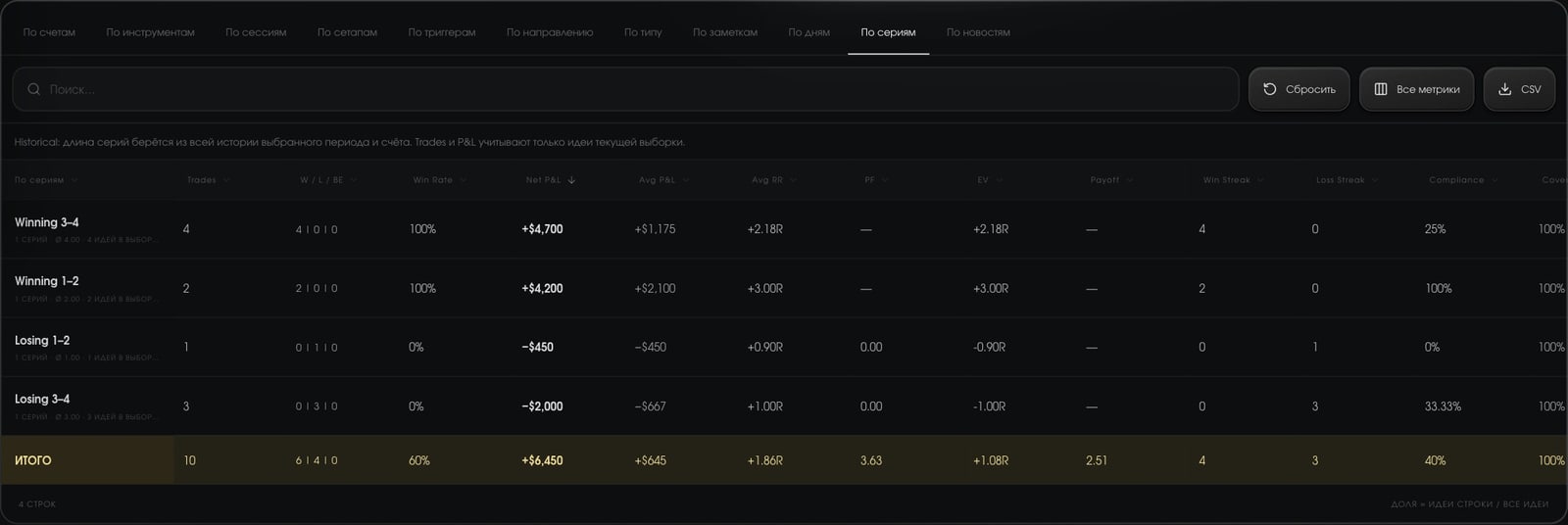
The streak breakdown uses ranges 1–2, 3–4 and 5+. A bucket groups runs by contextual length; its Trades count still refers to the selected represented ideas. Read series count and length separately from that membership.
Linked account executions are represented at idea level in strategy analysis. Several members of one idea are not independent repetitions of a decision. Check the combined result label and chosen account scope when tracing the sequence to the original records.
Streak labels do not require a known cash-risk denominator. A run can have a known length while an R-based measure is unavailable because its inputs are incomplete. Missing risk does not mean that the completed SL or TP record ceased to exist.
Check the source before interpreting the pattern
Save the period, account, mode, selected attributes and result filter with the row you are reviewing. Then trace one run back to the original records. Confirm which ideas are contextual members, which are selected and which opposite outcomes preserve boundaries.
The method for asking a precise statistics question helps you choose a mode for the review. These modes describe outcome sequences within the selected history. They do not identify motives, classify a reaction after the run or predict what comes next.