

After several SL results, identify the ideas in the run and open their records. Compare the saved plan with the action taken and the observations written at the time. Establish those facts before trying to explain the losses.
A sequence of negative outcomes does not by itself identify a broken model or a particular emotional state. The journal can help you examine the decisions and preserve uncertainty where the explanation is missing.
Define the run you are reviewing
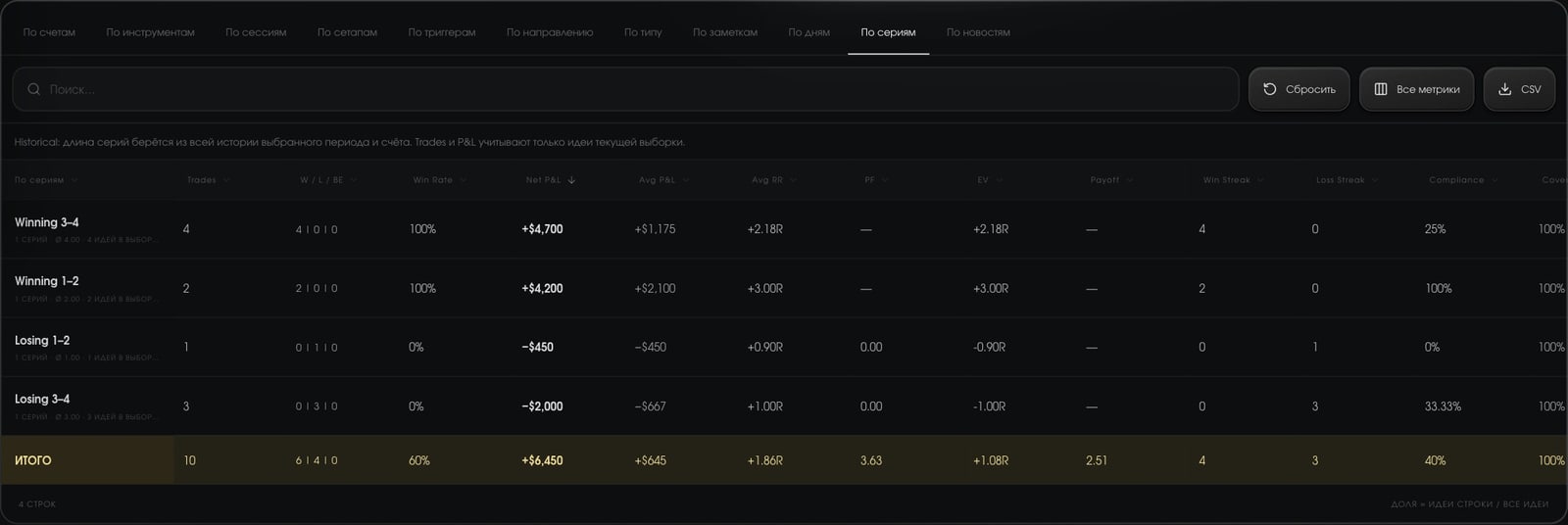
Choose the period and account scope, then check the result labels and linked ideas. Native losing streaks use SL outcomes. BE is skipped without breaking the sequence; plans and open positions do not supply completed outcomes. The Historical and Filtered modes can produce different lengths because they construct different context sequences.
Keep the displayed mode with your notes. A filtered model sample can contain only part of a longer historical run. Its selected idea count is not necessarily the length of the contextual series.
Also check the observation unit. One decision executed on several accounts should not become several independent examples of the same personal behaviour merely because several rows lost money.
Establish the facts of each idea
Open the underlying records and confirm the account, date, result, P&L and risk basis. Inspect linked executions where their outcomes differ. A risk number needs its percentage or cash unit, and a percentage needs the correct positive opening base for conversion.
Then look for the plan and timely evidence. What condition was required before entry? What management decision is documented? What remains unknown? A report can establish an execution without establishing the reasoning behind it.
For each idea, note the original condition, actual action, available evidence and unresolved question. You compile this review yourself from the existing fields; the app does not generate it automatically.
Separate a loss from a supported rule breach
Compare each action with a condition that existed beforehand. If the rule required a completed preparation checklist, check whether the available record shows the checklist's state at entry. If the earlier condition was never saved, preserve that gap.
A compliant assessment needs supporting information. So does a violation assessment. The absence of a discovered mistake is not proof that every rule was followed, and the SL label does not assign a violation automatically.
The Rule Compliance guide explains how Notes categories affect the calculation. Keep the event-specific evidence in the trade description so that a reusable label does not have to carry the whole account of each loss.
Preserve your own observations with their timing
Write what you actually noticed. A sample later note might say, “Evening review: I remember wanting to finish the day positive. I did not record that thought before the last entry, so its timing is uncertain.” That makes the observation usable without presenting a recollection as a confirmed cause.
A different record might contain a timely statement of an intention to recover the previous loss. That is material for the more specific review of trying to win losses back. An entry after SL is not enough to establish that motive on its own.
Keep factual actions separate from broad self-judgements. “Entered before the saved condition was complete” gives the next review something to check. A label about your character does not explain the execution.
Choose one question the run can support
Once the entries are checked, look for a concrete repeated circumstance. Perhaps the same preparation step lacks evidence, or several management changes were recorded only afterward. Include ordinary losses as well as the most memorable one so that the question reflects the defined run.
State the count and the gaps. If only two records have a usable earlier plan, say so. A confident account of every loss would overstate the available material. Reusable Notes can organize the supported observation, while a short comment retains the circumstances of each idea.
The run can also contain losses with different explanations. You do not have to force all of them into one category to complete the review.
Leave a manageable next recording task
Finish with something visible in the next record: save the original checklist state, capture the relevant management view, or distinguish a timely comment from an evening interpretation. Choose the task that addresses the uncertainty you actually found.
If you are returning to the journal after a pause, the return procedure can help organize that work. There is no universal break length or requirement to place another trade to recover the money.