

A profitable run is a useful point to compare procedures. Open the saved plan for a later entry and look at what changed: preparation, risk, entry conditions or management. If you noticed unusual confidence, record it in your own words and connect it to a specific action you want to examine.
Profit alone does not establish overconfidence. Check whether the procedure changed, stayed the same or cannot be reconstructed from the available evidence.

Name the change you actually observed
Start with a concrete statement such as, “I stopped saving the preparation image,” or, “I considered increasing the amount before the next entry.” The first describes an action in the record; the second describes a personal observation that needs its own timing.
A sample comment could read, “Written before entry: I feel certain about this model after the recent profits. The preparation checklist is still incomplete.” The thought and the checkable condition are recorded separately.
If the thought is recalled only during the review, identify it as a later recollection. Keep it separate from evidence that was already saved before the decision.
Define which profitable history you mean
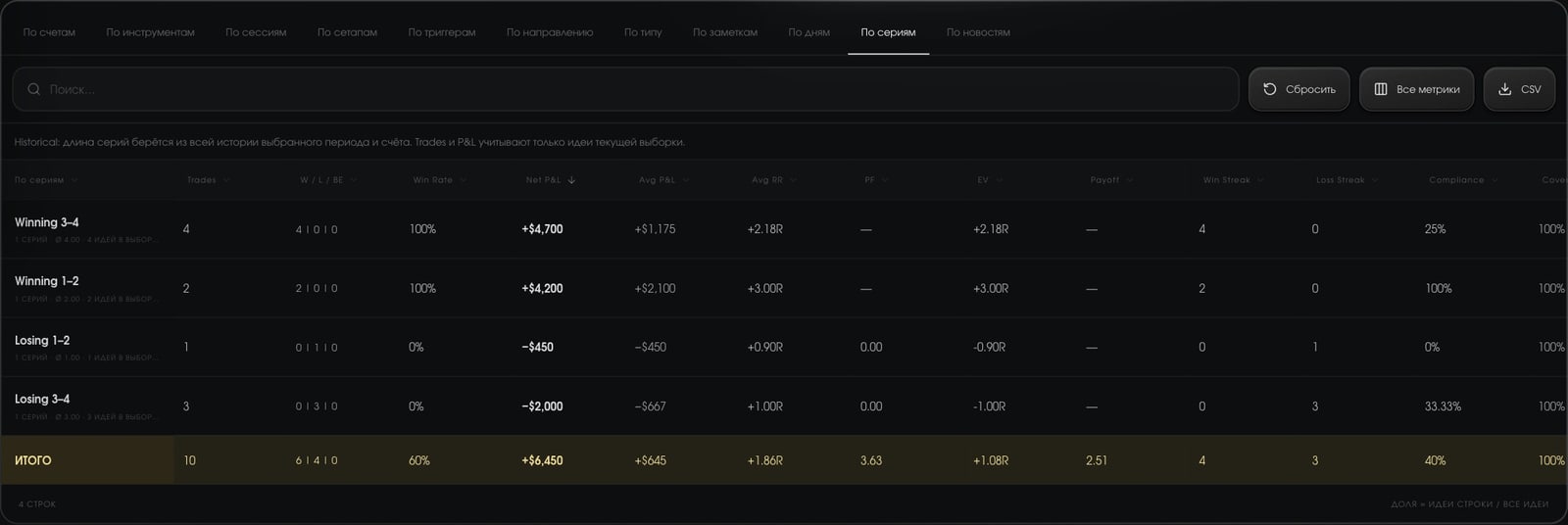
Choose the accounts and dates, then inspect the completed ideas. A native winning streak uses TP labels; a personal review of positive monetary outcomes needs to say that it is using money instead. These definitions can differ when labels and final P&L do not align.
Do not multiply one decision into several personal observations because it had executions on several accounts. Expand the linked idea to check individual financial differences while retaining the common decision context.
For the broader question of what happened next, use the manual review after wins and losses. Exact decision order needs evidence beyond two neighbouring rows on the same saved date.
Compare preparation and risk against prior conditions
Find the preparation material that was available before the profitable run and before the later entry. Check the same concrete steps in both. An empty field may mean the information was not recorded, so distinguish a missing record from a confirmed omitted action.
For example, at a $10,000 opening base, a change from 0.5% to 1% changes recorded cash risk from $50 to $100. Read the number, unit, account and Day Start together. The calculation establishes the size change, without explaining its motive or suitability.
Check whether a reason for the change was documented beforehand. A larger amount after several profits can be a supported fact while its connection to confidence remains uncertain. Preserve both parts of that account.
Assess conduct independently of the money
A later profit cannot establish that every rule was followed. A loss cannot establish that confidence caused a departure. Compare the specific condition and actual action before choosing a Notes assessment category.
The review of a profitable trade that broke a rule covers the case where the deviation is supported. Keep the real positive P&L and explain the known action. There is no need to change the financial record to make the process assessment visible.
If the earlier rule is unavailable or ambiguous, leave the assessment open. A label such as “overconfident” should not silently stand in for evidence of a particular breach.
Check how much of the history is assessed
Read the original comments and charts from ordinary profits as well as the largest one. If you labelled a personal state only after an unusual result, note that uneven coverage. The labelled group does not automatically represent the whole winning period.
Rule Compliance and Coverage describe different denominators. A fully compliant evaluated portion can coexist with several unrated ideas. Keep the unassessed area visible when describing how consistently the preparation procedure was followed.
If a record includes an observation about workload or tiredness, examine its actual timing and scope. The separate guide to recording fatigue and overload helps you describe what you noticed without inferring a health condition from the result.
Choose a check for the next review
Save the date range, idea count, observed change and the evidence you used. A bounded finding might say, “Risk increased in these records; only one contains a timely explanation. Check the preparation record on the next comparable entry.” This states what is known and what still needs information.
Apply the same recording procedure through profitable and losing periods, including cases where the procedure stayed the same. A winning run does not imply an inevitable reversal or supply a universal reason to stop or continue trading.