

To review a trade taken “after a loss,” first establish that the loss was already known when the later decision was made. An entry can appear below an SL record in a journal while having been opened before that position closed. The row order alone cannot supply the missing sequence.
This is a manual review of actions and available timing. Santrade does not provide a Performance After Streak filter or an automatic classification of your reaction to the previous outcome.

Define what “after” means for the question
Choose an event and a decision. You might examine the next preparation check after a confirmed close, or the risk recorded for an entry placed after that outcome became known. State which one matters before collecting examples.
Keep simultaneous or overlapping positions in mind. If two positions were already open, the close of one cannot explain the earlier opening of the other. You may still have a later management action to review, but that is a different event.
The guides to a losing sequence and a profitable sequence help define the starting history. This comparison adds the requirement to establish which information preceded the next action.
Use a comparable scope
Choose explicit dates and accounts, then identify the relevant completed ideas. Keep linked executions together when your question concerns one common decision. Inspect account members when the financial outcome known on a particular account matters.
Decide whether wins and losses refer to TP and SL labels or positive and negative monetary results. Use the same definition across the comparison, and retain BE cases separately where their status matters.
Include ordinary outcomes, not just the one followed by a memorable decision. A review based on the most striking pair of trades can overlook many cases where the routine stayed unchanged.
Establish the order from available evidence
Look for timely comments, saved plans and the terminal's execution history where available. Imported MT5 execution details can show actual execution times as reported by the broker. They do not establish when you read a result or formed a thought.
Journal streak calculations order closed records by saved date and ID. That is an ordering rule for the calculation, not an exact intraday record of when you knew an outcome. If the necessary timing is unavailable, mark the sequence as uncertain.
In your review text, distinguish actions confirmed before the outcome, actions confirmed after it and cases where the order is unknown. These are your own categories, not built-in reaction labels. Keep the evidence behind each choice.
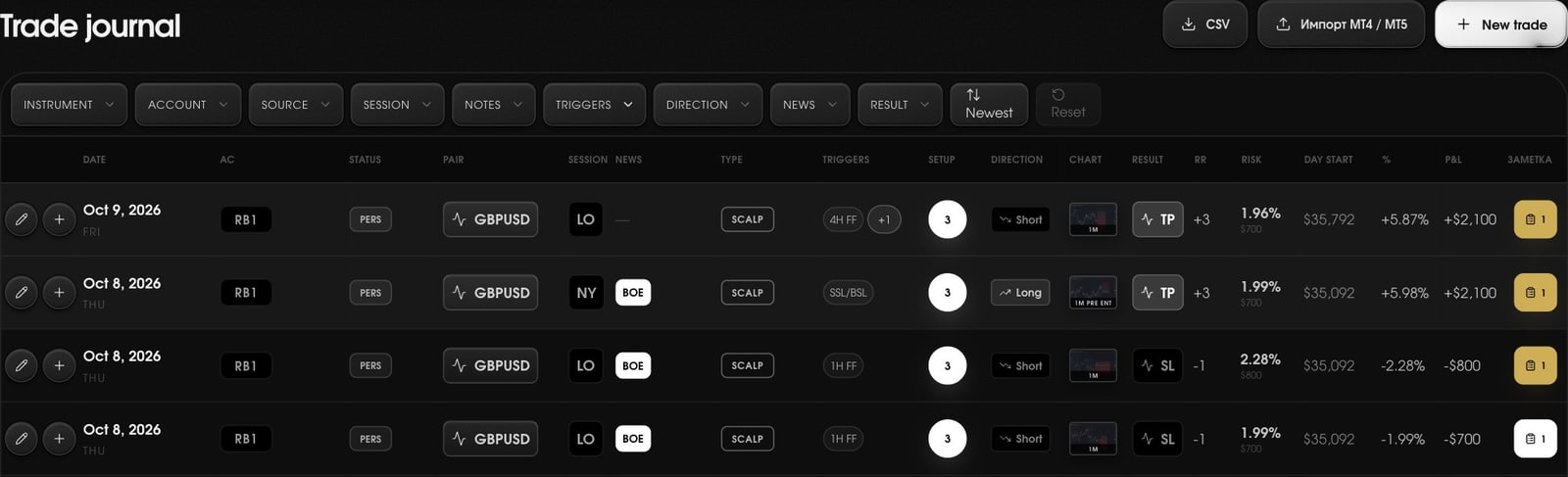
Compare a concrete action
Once the order is supported, inspect something observable: the preparation checklist, the entry condition, a management change or the recorded risk. Compare it with a rule or procedure that already existed.
A sample comment could say, “Previous position had closed before this entry. I completed the same checklist. Cash risk stayed unchanged. No timely note of my state was saved.” An unchanged procedure is also worth recording.
Where risk changed, check its unit and account base before describing the size change. Then distinguish the change itself from an explanation of why it occurred. Money and a thought recorded afterward provide different kinds of evidence.
Keep streak length separate from a reaction
Historical and Filtered Streaks describe sequences of result labels under defined scopes. They do not show that the next entry was a response to the sequence. BE is skipped in that calculation, and a hidden opposite result can still preserve a boundary.
Do not use a run length as a substitute for a timely observation of intention. If you wrote that you wanted to recover a loss, retain that statement with the relevant action. If the motive is unknown, leave it unknown even when the chronology is clear.
Also check differences in setup, instrument, risk and available opportunities between the compared cases. A changed action can accompany a changed situation without the preceding outcome being its established cause.
Improve the next recording opportunity
Save the question, account scope, event, action and timing source. Include cases with unchanged procedures and those where the order could not be established. That makes the limits of the comparison visible.
For later entries, a short timely note can state which outcome was known and what procedure you intended to follow. The method for one trading experiment at a time can help organize that narrowly defined recording task.