

To review a moved stop, find the management condition saved before the change. The same visible action could be permitted under one plan and outside another. Its meaning depends on the earlier instruction and the evidence of what you actually did.
Use the journal to preserve that comparison. Santrade does not move the broker order or automatically retain every stop-level change. Known levels, timing and explanations can be saved in your own text and images. Caption each known level with its account and source.
Recover the management condition
Open the original plan or model material. Identify when a stop change was allowed, required or outside the saved procedure. Include any exception that was already part of the rule rather than reading only the sentence that best fits the later result.
The plan-versus-execution review helps distinguish an earlier condition from a rule proposed afterward. If you formulate a new management idea during review, label it as new. It does not establish what the old position was supposed to follow.
If the original wording is missing, keep that limit in the record. A later chart may explain a proposed rule, but it cannot recover an overwritten earlier version or an unrecorded intention.
Describe the supported change
State what changed and which source supports it. A timely screenshot, your own comment or available order history may preserve different parts of the event. Verify the account when the idea has several executions, since one account's action need not describe every member.
A sample comment could read, “Before management: plan requires the named confirmation before changing the stop. At the change: confirmation not yet present; I moved the order anyway. Screenshot captured then. Evening review: reason for overriding the condition still unclear.”
The sample sets out the sequence without assigning a motive. If an earlier or later stop level is unknown, say so. A plausible-looking price on the completed chart cannot supply that missing information.
Keep the decision stages readable
Label the stages in your text, for example “Original condition,” “Change” and “Later review.” Caption each image with its timing and the claim it supports. You create these stages yourself; the app does not supply a timeline of stop movements.
Where a second change occurred, preserve its own condition and evidence. A single sentence saying “managed the stop” may conceal several decisions with different grounds. Keep the review focused on the particular change you can establish.
If the next action was an early close, use the separate exit review. A stop adjustment and a full or partial exit are different events even when they belong to the same management sequence.
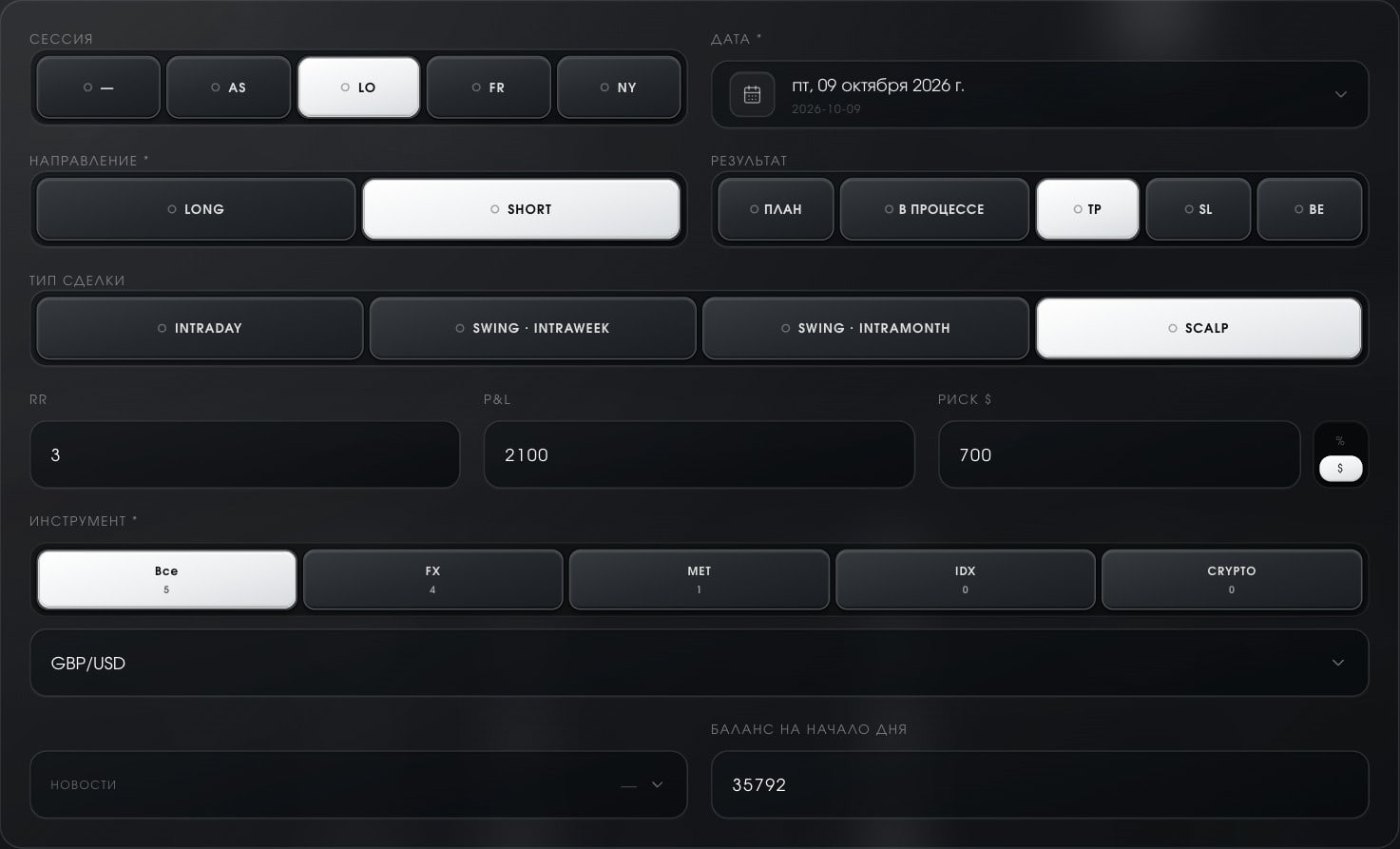
Assess the action against the known rule
Compare the saved condition with the supported action. An adjustment may follow a permitted management rule or depart from it by preceding a required confirmation. Where the evidence is missing, leave the assessment open.
Choose a Notes category that matches the assessment. A personal observation about discomfort can remain neutral, while a known rule breach has a different analytical meaning. The name of the card does not establish either category by itself.
Keep the actual financial result. A profit after the change does not erase a supported departure, and a loss does not establish that every stop move was wrong. The record needs both the action and its outcome without making one substitute for the other.
Preserve the risk basis you are reporting
Check the risk number and unit attached to the record. The saved risk supplies a basis for realized calculations; it is not an automatically reconstructed history of exposure after every order change.
If your review discusses risk at several stages, state what each value describes and when it was established. Do not replace the original basis simply to make the final R larger. An uncertain earlier risk should remain uncertain until a source supports it.
For a linked idea, inspect individual executions as well as shared text. A main-record edit can propagate common context, so identify an account-specific action clearly before writing it as though it applied everywhere.
Save a future rule as a future rule
The review may suggest making the management condition more explicit or preserving an image at the change. Write the proposed improvement separately from the earlier plan and choose when you will use it in later records.
Use the method for turning an insight into a rule to define the next task. Save the new condition with its later origin. A different stop placement does not come with a guaranteed fill at a preferred price or a better financial result.