

“Trading around news” needs a definition before it can become a useful journal category. It might mean entering before a known event, holding a position through it, or managing a trade afterward. The same event label can otherwise combine situations you meant to examine separately.
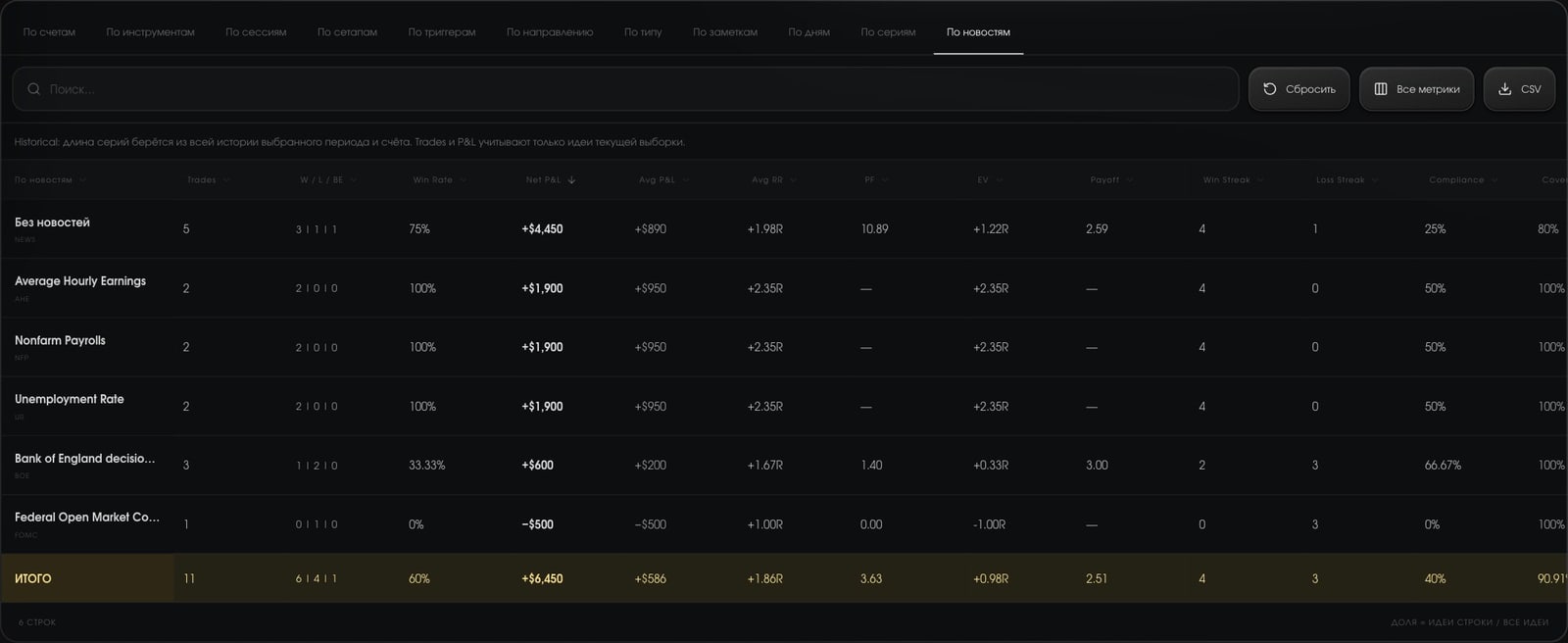
Santrade lets you attach news labels to a trade and review them in Deep Analytics. You supply the relationship between the event and your decision. A saved abbreviation does not automatically measure the market's reaction or explain the result.
Define the relationship in your own records
Write what makes an entry part of the review: the known event and the timing relationship that matters to your question. Use a consistent clock and explain it in your reference material. Avoid changing the definition after finding a profitable group.
A sample comment could read, “Known event was scheduled while this position was open. Reviewing the management decision made before it.”
Check the meaning of your session labels if you use them alongside the event. A session code alone does not establish the timing of a particular release.
Add the event label you can support
The trade editor includes a catalogue of event abbreviations, names and reference priorities. You select the labels manually. A trade can contain up to five news labels. Use the source information you have rather than reconstructing an event association from a dramatic finished chart.
An abbreviation identifies the event type represented in the catalogue. Its reference priority is not a judgement of the quality of your entry or proof that it affected this instrument. Keep the event label separate from your process assessment.
A short comment can preserve whether you knew about the event before entry, noticed it while managing the position or added the label in a later review. That distinction gives the future reader more to examine than the abbreviation alone.
Include the unlabelled and losing records
Choose the dates and account scope, then inspect the news breakdown and filters. Retain the relevant losing and BE outcomes as well as profits. A winners-only view cannot describe the complete recorded result associated with the label.
The no-news option means no news label was saved. It does not verify that the market had no scheduled events. Use the missing-details workflow to complete supportable gaps while leaving uncertain associations unknown.
Compare the amount of documentation on both sides. If you label events only after large moves, the tagged group is already selected by a memorable outcome. State that limitation rather than treating the existing labels as a complete event history.
Account for overlapping event groups
One idea can carry several event labels and appear in several news rows. Suppose the first of three ideas has CPI and NFP labels, the second CPI only and the third NFP only. Each row contains two ideas, while the distinct sample contains three.
Adding those row counts would count the shared idea twice. The same issue applies to money contributions and shares. The total for the represented sample should preserve each idea once rather than adding overlapping rows.
Tags can be combined across linked account executions. If your question concerns what was known for one execution, open that member's record. An idea-level association does not prove that every account member had an identical event-specific decision.
Read what the label cannot establish
The catalogue is not a live feed of actual releases, an automatically detected event window or a measure of surprise. A label also does not calculate how much slippage or price movement the event caused.
Check the instrument, model, risk and period composition before explaining a difference. A news group may contain different trading circumstances from an unlabelled group. Use a separate session comparison where that timing definition matters, and retain the changed scope.
Return to the saved plan, comments and images for actual decisions. If the evidence supports only an association between a label and a recorded outcome, keep the conclusion at that level.
Preserve the next recording question
Save the event definition, dates, accounts, idea counts and missing-label limitation. Identify the next piece of information that would make a review clearer, such as whether the event was known before entry or which management condition applied.
The filter-overfitting guide helps when event, instrument and session combinations keep revealing more attractive past subsets. A useful news review builds a consistent personal record.