

For a prop payout, distinguish the full payment basis from the amount received after the trader share. Santrade's Money Log asks for the full payout and previews the amount counted for the trader. Entering an already reduced amount as though it were full can apply the share twice.
Check the actual date, historical Live basis and source confirmation before saving. The journal records the event; it does not initiate the provider's transfer or verify that the money reached a bank.
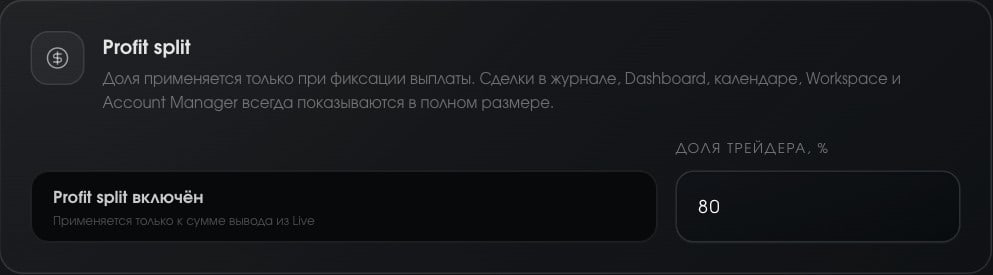
Confirm the applicable Live history
Open the prop account's phase history and the payout date. The interface uses the applicable historical Live share, rather than requiring that every old receipt be interpreted through the current status alone.
The date cannot precede the available Live start. An account that later changed status can still have historical Live information relevant to a received payout. Keep that history intact instead of rewriting it to match the account's latest label.
The phase-history guide explains the boundaries. The percentage saved there is information you maintain about the account, not a guarantee of a provider's current terms.
Enter the full amount once
Suppose the full payout is $1,000 and the applicable trader share is 80%. The preview is $1,000 × 80 / 100 = $800 received. Check those separate amounts against the source for your own payout.
If you enter $800 into the full-amount field for that same event, applying 80% again produces $640. That would describe a different full payment. It does not preserve the original $1,000 event whose received amount was $800.
If your source shows only a received amount, establish the full basis and applicable share from the confirmation before using that field. Do not assume the interface has a separate net-input mode or infer the right amount from a figure you want the preview to show.
Keep the trading result separate
Profit Split applies to the payout record, not to each trade's P&L. The Journal retains the full trading result represented in its source, including trading expenses already included there. Do not multiply every trade result by the payout percentage.
An unpaid positive trading result is also different from a received payout. Capitalization treats prop receipts according to its own basis; a nominal allocation or a profitable Live record does not automatically become received personal money.
Keep the original risk basis when reading R measures. Payout sharing changes neither the original exposure recorded for a trade nor the actual execution sequence used to understand it.
Save the event with its evidence
Use the actual payout date and inspect the full and previewed received amounts together. An optional image or supported link can retain a confirmation for later review. It is user-supplied evidence, not an automatic banking verification.
The payout-history guide covers keeping those events and attachments readable. A statement from the provider and a receipt on your side may describe different stages, so identify what the source you saved actually confirms.
If the date or share is wrong, correct the underlying source account information deliberately and check the saved operation. Adding a second fictitious receipt to make a total match would create another cash event rather than fix the first one.
Reconcile the different money views
Money Log retains the received amount and the full payout basis. The trading ledger and own-capital view use those quantities for different questions. Read the figure's meaning before expecting every displayed number to equal the amount that arrived after the split.
The Money Log guide separates operations from trading results. A withdrawal entry in the prop account is the record of a payout, while a deposit in a personal account has its own source and should not be invented as an automatic consequence.
Check account identity, date and source when totals look different. The app does not consolidate external bank balances or reconcile every third-party transfer automatically.
Reopen one known payout
After saving, inspect the row and attached confirmation. Identify the full basis, share, received amount and date before using a figure in a total.
Give each amount a label in a written review: “Full payout $1,000; trader share 80%; received $800.” The labels let a later reader follow the source without guessing what the single largest number means. Retain actual cents where they occur, and compare the saved figures with the confirmation rather than rounding them to make the pair look simpler.
Keep these labels when reusing an amount in a review. A past payout establishes neither a future payment nor the provider's future share. Leave any unconfirmed part of this event with a source-check question.