

A prop-program allocation, an unpaid trading profit and a received payout are different figures. Capitalization helps describe recorded own capital using the account type's rules. It should not be read as a consolidated valuation of every external bank, broker or crypto asset.
Start by naming the quantity you are looking at. The same account can have a trading result, a ledger balance and received cash history without those numbers being interchangeable.

Read the account type before the amount
Personal and Crypto accounts follow their own cash ledger. Prop accounts with historical Live information contribute received net payouts after the relevant Live start, rather than their program allocation.
The account-type guide explains that distinction. A challenge allocation may be large while representing no personal receipt. A Challenge trading result is also outside the prop own-capital amount.
Check the relevant dates as well as the current status. An account that once reached Live can retain applicable payout history after its status changes. Reading only the current label can hide why an earlier receipt still belongs to the account's recorded capital.
Follow the cash-account ledger
For example, $10,000 opening funding plus a $500 deposit, less a $200 withdrawal, gives $10,300 before additional trading results. With $300 recorded closed P&L, the closing ledger becomes $10,600.
The deposits, withdrawal and trading P&L perform different jobs in that calculation. Confirm the opening funding once rather than adding a duplicate operation because the same amount also appears in the account's setup.
A trade's Day Start is a reference for its own metrics. It is not automatically a new deposit or a reset of the cash ledger whenever a later record contains an opening balance. Inspect the actual recorded flows when reconciling the capital figure.
Count prop receipts without adding the allocation
Suppose a prop account has a $100,000 allocation and $1,200 received net payouts. Prop Capitalization counts the relevant $1,200 receipts, not $101,200. An unpaid result in the Journal adds no received cash.
For example, a $2,000 trading result still awaiting payout can remain a trading result while received payouts remain $1,200. Keep the source of each amount visible instead of turning every positive figure into personal cash.
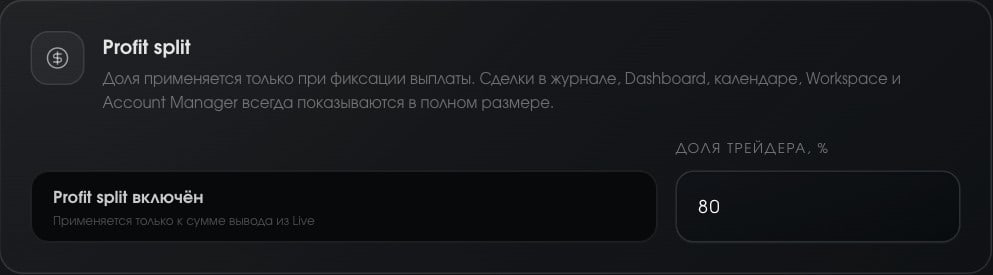
The Profit Split guide explains how the full payout and received amount are related. Capitalization uses the received net side for this prop purpose, rather than applying a fresh split to the already reduced amount.
Distinguish receipts from the trading ledger
The prop trading ledger can reflect allocation, recorded trading cash and full payout deductions. The own-capital view asks what has been received through the applicable payout records. A disagreement between those quantities can therefore follow their definitions.
Check a payout's saved history when the receipt total is unexpected. Inspect the account, date, full amount, share and received amount. A confirmation image can help you review the source, but it does not independently verify an external bank movement.
Do not create a fictitious transfer simply to force one view to match another. First establish whether they are measuring the same thing and whether the source operation was recorded once.
Keep period return and NOW separate
Dashboard PnL % uses its selected period's trading basis. NOW describes the selected period's closing ledger amount; on a past month, it is not a live balance for today. Capitalization has a different purpose from either of those labels.
The explanation of return versus balance change covers the percentage bases. A new deposit can change capital without being trading profit, while a prop payout can be a received cash event without reducing every trade's P&L by its share.
Retain the selected dates and account scope in a review. A monetary total and a percentage should not be compared as though they described the same denominator or the same boundary of time.
Trace one amount back to its event
Choose a figure you know and follow it to the underlying operations. For a cash account, inspect funding, transfers and trading P&L. For a prop account, inspect the relevant historical Live basis and net payout records.
Date matters even when no new trade occurs: a later recorded payout can change prop Capitalization while the model’s past trade P&L is unchanged. Read the operation’s date rather than assigning that cash to the day of a remembered win.
Save an unresolved difference as a source question, not a balancing entry. State whether each figure is allocation, unpaid trading result or received money before comparing it with another view. None is a consolidated measure of external wealth.