

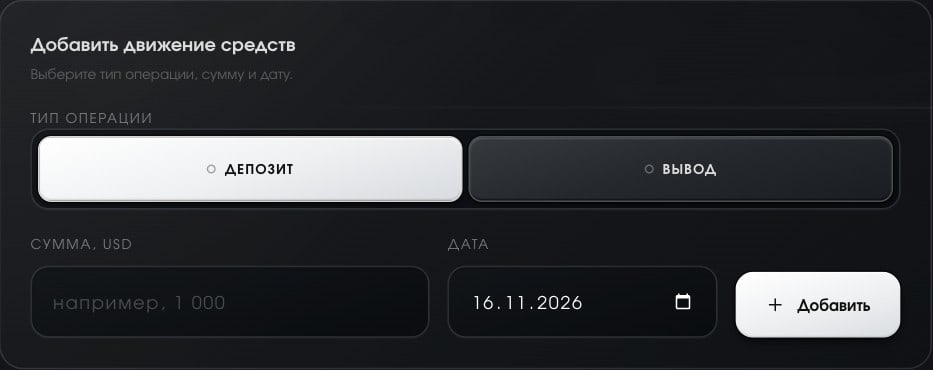
Money Log records actual cash movements separately from trading P&L. Begin with the event: which account received or paid money, on what date and for what positive amount? The operation type supplies the direction, so a withdrawal should not be entered as a negative deposit.
A journal operation changes the recorded calculation. It does not execute a bank transfer, connect an external wallet or establish that a payment occurred without a source.
Check the opening operation first
When creating a Personal or Crypto account, the opening workflow can create a linked starting deposit. Inspect Money Log before adding the same funds again. An amount appearing in the account's setup does not mean it needs another independent cash operation.
If the opening history is incomplete, identify what source would establish it. Do not supply a convenient deposit solely to make the latest balance match a report. The balance-reconciliation guide can help separate missing history from a difference in calculation.
Keep the account's opening date accurate. New cash operations need a valid date that does not precede the account's opening. A historical event should be recorded against its actual source context rather than moved into the current day for convenience.
Choose the correct operation type
Personal and Crypto accounts support deposits and withdrawals of own funds. Enter a positive amount and the actual date, then check the account before saving. A trade's profit or loss belongs in its trade record rather than being added again as a cash transfer.
For Prop accounts, a payout is recorded as a withdrawal with an applicable historical Live basis and trader share. That is a different route from depositing personal funds into a cash account.
The payout-history guide covers the receipt and optional evidence. Do not assume every account type uses the same meaning for an opening allocation, a withdrawal or received personal capital.
Follow a small cash example
Suppose a Personal account has $10,000 recorded opening funding. A later $500 deposit and $200 withdrawal leave $10,300 before additional trading P&L. If the relevant closed trading result is +$300, the closing ledger is $10,600.
The $500 deposit and $200 withdrawal are transfers, outside the trading result. Keep their sources separate from the recorded P&L; these sample amounts do not prescribe how much to fund or withdraw.
Read the operation rows and trade results separately when reproducing the total. If the account's starting funding is already represented by the linked opening deposit, adding it again would count the same source twice.
Use the date convention consistently
Deposits are available at the opening of their date in the journal's date-based calculation. Trading P&L and withdrawals are booked at closing. This convention matters when checking an opening reference for a trade on the same date.
The Day Start guide explains that reference. Saving a manual opening balance in a trade does not itself create a deposit, and a later snapshot does not simply reset the ongoing cash ledger.
Imported MT5 positions can have execution cash on dates before the final closed record. Inspect those events when a day's available balance seems surprising instead of treating the final idea P&L as though all its cash occurred at one instant.
Confirm the saved event and correct its source
After saving, check the account, type, amount and date in the operation list. If the source is wrong, correct the recorded history deliberately. Adding a fictitious offsetting event can make a total look right while leaving an inaccurate explanation of the money.
Deleting an operation changes the journal's calculation; it does not reverse the external deposit or withdrawal. Read the confirmation and preserve any source information you still need before removing a real recorded event.
The app does not automatically recognize every transfer, convert arbitrary currencies or verify a bank receipt. Keep the available source and the meaning of the amount with your own account of the operation.
Reconcile money and return as separate questions
Use explicit dates and account scope when comparing the ledger with another view. A balance increase can contain funding as well as profit. The return-versus-balance guide explains why its percentage need not equal a trading-performance percentage.
Use a short source note in your review when the displayed amount is easy to confuse with another figure, such as a statement balance or an already recorded opening. The note should explain the actual event rather than supply another adjustment.
Trace the total to opening funding, actual operations and trading cash. Keep a source-check task for any missing history instead of adding an adjustment to reach a preferred balance.