

A prop account's current status is only one part of its history. To interpret an earlier trade, you need the phase that applied on that trade's date. Preserve the actual boundaries between Challenge 1, Challenge 2 and Live before comparing their results or recording payouts.
The journal records the dates and conditions you supply. It does not determine that a provider's challenge was passed, monitor its limits or verify the provider's rules for you.
Start with the dates you can support
Find the source for the account's opening and phase changes. Use the actual dates rather than choosing boundaries that make the result more attractive. If the timeline is incomplete, identify which transition needs confirmation.
The account-type guide separates a prop-program history from personal or crypto cash accounts. A challenge result is not automatically personal capital, and the program allocation is not a received payout.
Keep provider rules as source material where they matter to your review. A status label in the journal does not establish that every external requirement was satisfied or that the recorded program terms are current.
Keep the phase periods coherent
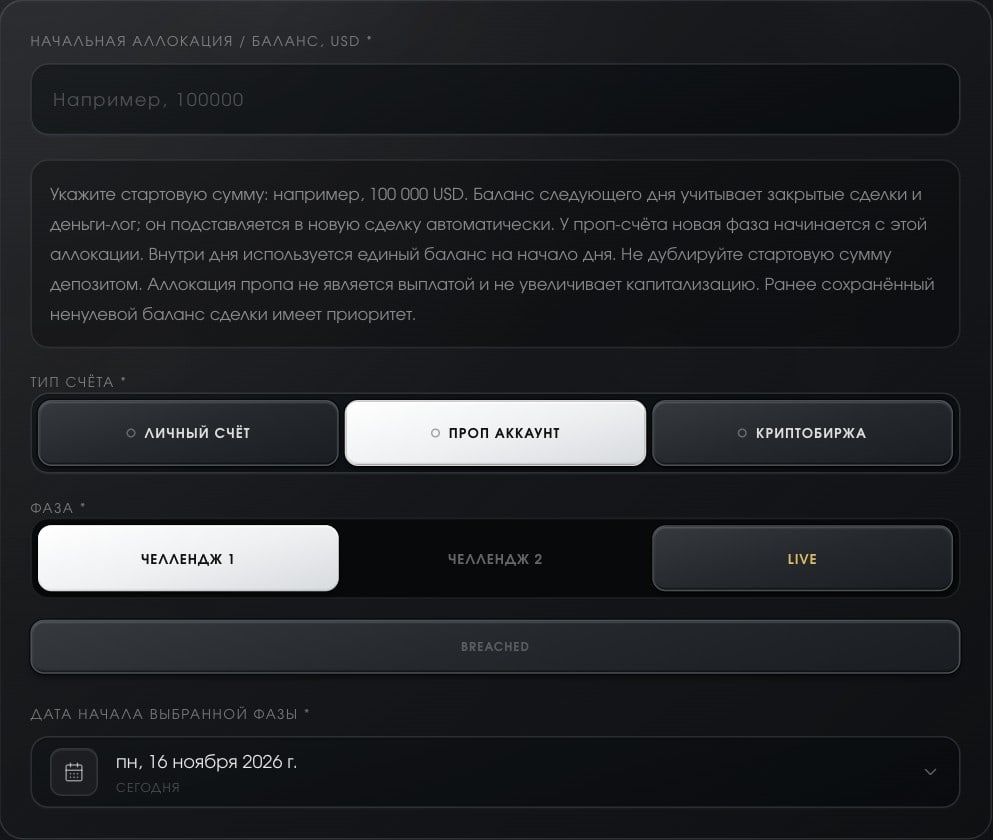
Enter phase boundaries in their historical order and inspect the dates around each transition. Neighbouring periods should not overlap. The account interface includes confirmation for a status transition, so read what period the change will create before saving it.
A sample source note could say, “Challenge 1 ended on the recorded date; Challenge 2 began afterward. The first Live date is supported by the provider notice.” Replace that sample sequence with the dates your sources establish.
Reopen the saved history and check the boundaries. A current label alone cannot show whether the trade just before or after the transition was assigned the intended historical context.
Inspect trades near a transition
Use the saved trade date and account to check which phase applies. Pay particular attention to records close to a boundary and to source timestamps that may need interpretation in their reported clock.
A report can supply actual execution times, but the saved record date still needs a clear basis. Do not move a loss across a boundary to make one phase appear cleaner, or assume that the latest account status should replace every earlier phase.
Linked account executions can have different phase contexts. Expand the idea when that matters, retaining the individual account record rather than applying one current label to every member.
Preserve historical Live information
In the interface, the funded phase is labelled Live. Its historical dates and trader share matter for payout recording. A payout cannot be dated before the available Live basis merely because the account is currently in a later state.
The Profit Split guide explains how the applicable historical share is used. Check it for the actual payout date instead of applying whichever percentage you remember most recently.
A later status change does not erase the fact that the account previously had Live history. Relevant recorded receipts remain part of that history. Avoid reducing every trade's P&L by the payout share; trading results and cash receipts have separate roles.
Keep an ended attempt separate from a new one
Breached represents the end of an attempt. The interface does not let the same ended account simply become a new Challenge 1 or Challenge 2 attempt. Create a separate account for a new attempt and retain the old records.
The failed-challenge review uses the preserved phases, decisions and known rules. A fresh ticker can distinguish the new history without deleting the prior losses or pretending they occurred on a different date.
This separation also keeps payouts and allocation meanings traceable. A new nominal program amount does not replace money previously received, nor does a past Live phase guarantee a further payout.
Read the whole timeline after saving
Check the opening date, phase periods, current status and examples from both sides of a transition. Confirm that old entries still have the intended context and that any historical Live share used for a payout has a source.
In your transition note, identify the date source, the phase containing the neighbouring records and the dated basis for any Live share. This is your own check, not an automatic pass certificate. Leave an unclear boundary as a verification task.
Use the Capitalization guide to interpret the amounts. The phase history neither verifies the provider's rules nor initiates payment or guarantees success in another attempt.