

Preserve the ended challenge as its own history before planning any new attempt. Keep the actual phase dates, trades and known provider conditions together. A clean new start in the journal does not require deleting the record that could explain the earlier decisions.
The review can finish with one supported process finding and one next recording task. It does not decide readiness, refund a program or promise that a later attempt will pass.

Confirm the ending and its source
Check the account and source evidence for the ended attempt. Record the appropriate Breached status and inspect the historical boundaries. Do not infer an external provider rule solely from a journal result or a label in a personal note.
Retain the program conditions that were actually known for that attempt where they matter to the review. If you cannot establish a particular requirement, mark the source gap instead of inventing the rule most likely to explain the outcome.
The phase-history guide separates current status from earlier Challenge and Live periods. An ended account can retain previous trades, phase context and any applicable payout history.
Complete the factual history without reshaping it
Check that the supported import or manual records contain the events you intend to review. Confirm dates, actual P&L, risk units and account identity. Partial exits and linked executions need their own unit rather than being counted as new independent decisions.
Leave old losses on their supported dates. Moving them outside a phase or deleting them to create a more attractive start would change the record under examination. A correction needs an actual source, not a preferred summary.
Retain gaps in context too. A report can confirm executions while leaving plans and motives unknown. Mark explanations added after the attempt ended as later accounts, rather than presenting them as timely evidence.
Choose one action question
A useful question might be, “Which management changes have a saved earlier condition?” It directs attention to evidence across different outcomes rather than asking every losing record to confirm a single personal explanation.
Use the losing-streak review for a defined run where relevant, but keep its result sequence separate from a reason the whole attempt ended. A run alone does not establish a broken model or an emotional cause.
Read ordinary cases as well as the final or largest loss. The last visible event may explain an external ending without representing every decision in the account. Keep the scope of each finding clear.
Assess only supported conduct
Find the condition that existed before the action and inspect the evidence. A known departure can be named directly. A loss does not assign a violation, and the absence of a discovered mistake does not prove compliance.
Rule Compliance and Coverage help describe the assessed portion and how much history remains unassessed. A few documented cases should not silently stand for the entire challenge.
Personal observations can be preserved with their timing. A statement written during a later review should remain a later account, rather than becoming evidence that the same motive was present at every entry.
Save the next procedure separately
Write a small recording change based on the gap you found: preserve the original condition, add a timely management reason or verify a missing risk basis. State what would show that the recording step was completed.
The return-to-journal procedure can organize this work without requiring an immediate market entry. A review session that clarifies one supported event is a completed task in its own right.
If you change a model or rule now, retain its new origin. It is a proposal for later use, not a requirement the older attempt is retrospectively claimed to have followed. Keep financial outcomes and the source of the new idea distinguishable.
Use a separate account for a new attempt
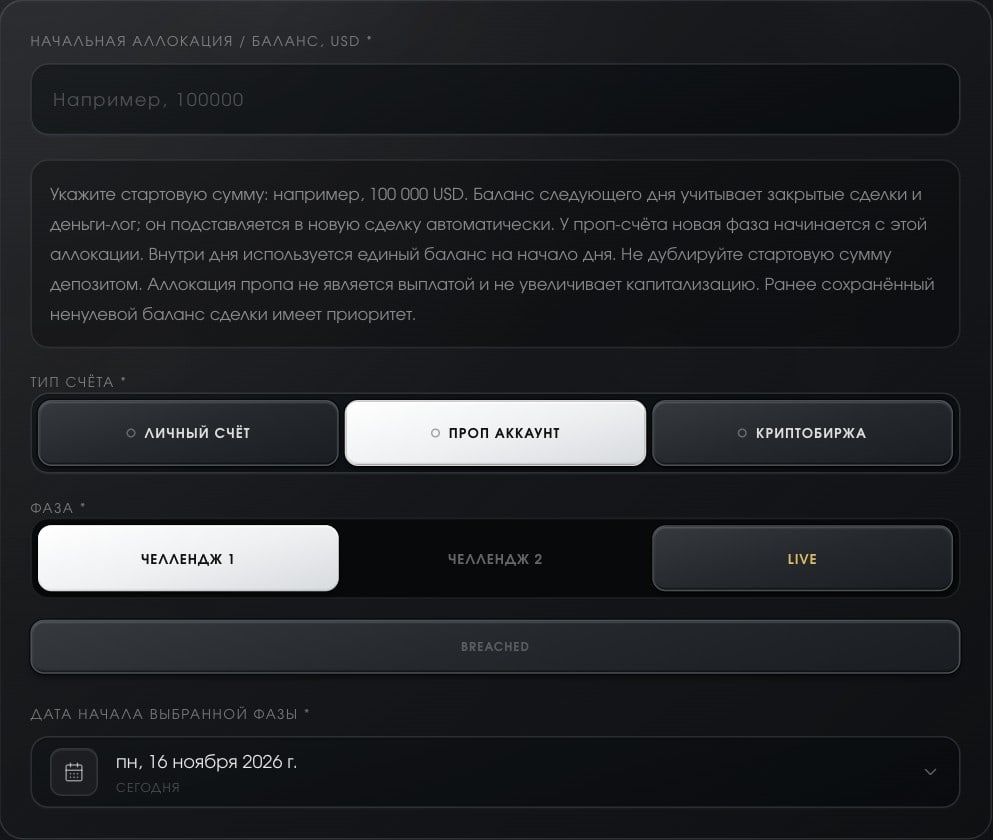
After Breached, the interface requires a new account for a new Challenge 1 or Challenge 2 attempt rather than cycling the same ended account back into a fresh start. Use a recognizable ticker and the new opening details when an actual new attempt exists.
Keep the earlier account available for comparison. Its nominal allocation and challenge results do not become received own capital merely because the program has ended. An old payout also does not imply that another one is guaranteed.
Keep a short index of the source material used for the review: phase notice, relevant rule wording and the records supporting the selected action question. This makes the next reading possible without recreating the provider’s whole history from memory.
Keep the preserved history and next recording task available even if you choose not to begin another attempt. Leave unresolved evidence open. The journal does not verify the provider's rules or guarantee recovery.