

An MT5 report can show many execution rows for a single position. Santrade reconstructs the supported history before you choose whether some new positions represent one trading idea. Understanding these units helps you read the preview and interpret the later counts.
Start with the report's structure and identifiers. Hedging and netting describe how positions are accounted for; they do not explain your personal reason for a decision. That explanation remains something you record yourself.
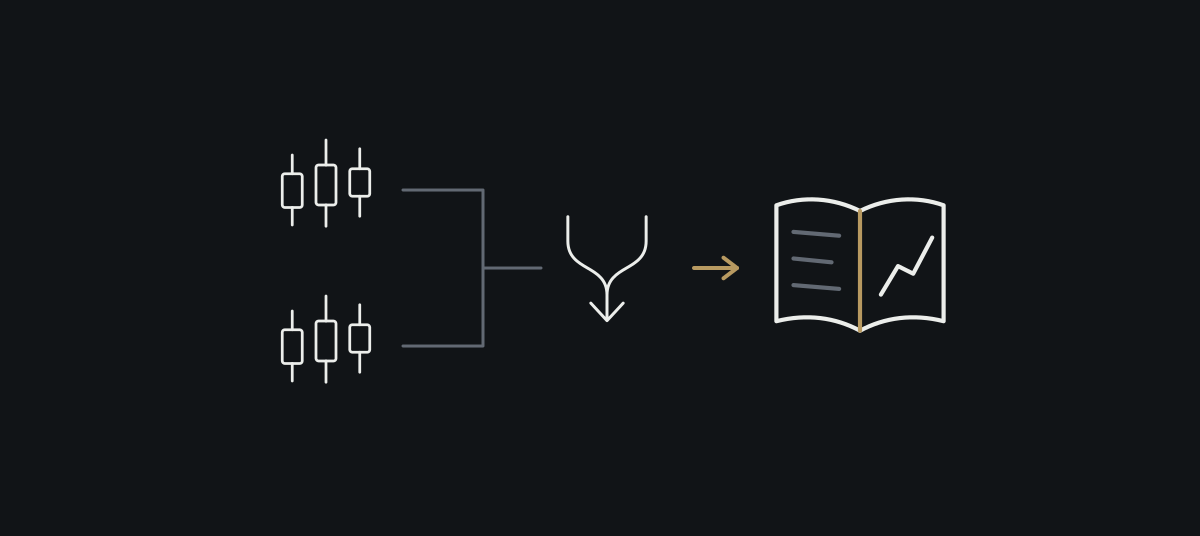
Distinguish the three units
An execution is a reported operation, such as opening volume or closing part of it. A position is the reconstructed sequence linking the relevant entries and exits. An idea is the journal's level for the trading purpose you choose to record.
Several executions can therefore belong to one position, and suitable newly imported positions can be grouped into one idea. The number of source rows need not equal the number of journal ideas or independent decisions.
Use the MT5 import walkthrough for file preparation and saving. Before grouping, check which positions the execution rows belong to.
Follow volume through a netting sequence
In netting, the same instrument has one position at a time. Further same-direction operations can add volume, while opposite operations can reduce, close or reverse it. The importer needs the earlier history to establish the remaining quantity.
Suppose an entry opens one unit, another adds half a unit and an exit removes three quarters. The remaining quantity is three quarters of a unit: 1 + 0.5 - 0.75 = 0.75.
A reversal needs both sides of the transition. An opposite operation larger than the existing position can close that position and leave new volume in the other direction. Santrade separates the closed and new portions in supported reconstruction rather than counting the same costs twice.
Read hedging history through its position identities
Hedging can contain separate positions in the same instrument, including positions in opposite directions. Matching a symbol alone is therefore insufficient to decide which earlier entry belongs with a later exit.
Santrade uses available position information and checks the consistency of the history. It does not guess arbitrary pairings between simultaneous hedge positions. Depending on the report's information, supported summary history may be retained or an unreliable reconstruction may be stopped for review.
If the report is ambiguous, obtain a more complete suitable source. A missing identifier or initial entry is a data problem to resolve. Inventing the intended pairing would make the resulting history look more precise than its evidence.
Group only new positions that belong together
In the MT5 preview, assign the same idea number to new positions when they share the same instrument and direction and you intend to review them as one idea. You supply that classification; the importer does not infer the trading purpose from the report.
Suppose two new same-side positions were parts of one recorded plan. You can consider grouping them after checking that plan and the preview. Two unrelated entries in the same direction on the same day need not be classified together merely because those visible fields match.
A group containing both new and already imported positions is blocked in this workflow. The repeat-import guide explains this boundary. Choosing a group before saving new positions does not provide a general merge action for old records.
Check closure and the underlying cash events
A completed position requires a full close. Before then, individual executions can already have reported cash effects. A later report can establish final closure while retaining the earlier dates of those money events.
The partial-closes explanation follows a cash example across days. It also distinguishes the Calendar date of a completed record from the ledger dates of its executions.
MT4's closed-ticket handling is different. Avoid transferring the MT5 grouping explanation to every MT4 partial ticket or assuming that the same-looking summary must arise from the same underlying unit.
Use the unit consistently during review
When you count a recurring action, ask whether you mean separate executions or independent ideas. One idea represented by several operations does not establish that the same decision was repeated independently that many times.
Add the personal context needed to explain your grouping, and preserve what the report actually supports. If the purpose of an old entry is unknown, leave that uncertainty visible rather than deriving it from its eventual P&L.
There is another distinct relationship when one idea is executed across accounts. Keep that account-level structure separate from the reconstruction of an MT5 position.