

A partial exit can change account money before an MT5 position is fully closed. Later, the journal may show the whole idea on its final closing date. Those two views can be consistent because they organize the same history around different events.
Start by identifying the unit you are reading: an execution, a position or a trading idea. A partial exit is an action within that history. It does not automatically become an independent idea or a second occurrence of a decision error.
Read the position as a sequence
A supported MT5 report can contain the initial entry, additions, partial exits and final exit. Santrade uses those executions to reconstruct the position. A closed record needs the history that establishes how the volume was opened and fully removed.
The positions and idea-grouping guide explains the units in more detail. Several execution rows are not necessarily several separate trade records, and deliberate grouping can add another level.
Keep the complete source when choosing a reporting period. An exit without its original entry is insufficient for reliable reconstruction. Extending the export window is preferable to inventing a missing opening event.
Follow the money through one position
Suppose a Personal account has a $10,000 opening balance and no deposits or withdrawals. Follow one MT5 position through these simplified cash events:
- Monday: entry commission of -$2.
- Tuesday: a partial exit earns $40 and incurs a -$1 commission, net +$39.
- Wednesday: the remaining exit earns $60 and incurs a -$1 commission, net +$59.
The total net result is -$2 + $39 + $59 = +$96. Floating P&L is excluded from these sums.
The same position has several dated money events and one final closure. A question about its Tuesday balance requires different reading from a question about the date on which the completed idea enters closed-trade analysis.
Check when money enters the balance
The account ledger uses actual dated imported cash movements. In the example, the closing balance is $9,998 on Monday, $10,037 on Tuesday and $10,096 on Wednesday. The final amount incorporates all three events once.
Tuesday's increase is therefore visible in money history even though some position volume remains open. This is realized cash information from the executions, rather than an estimate of what the remaining volume might earn.
For a discrepancy, use the balance reconciliation guide. Check the underlying event dates and costs before assuming the journal has duplicated or lost a trade.
Check the date of the completed record
In this single-position example, the completed idea is dated on Wednesday, its final close. Its full net result is +$96. That date is the basis for the closed record rather than a separate completed idea for every earlier money event.
Calendar groups closed records by their recorded date. It does not display every MT5 commission or partial-exit cash event as a separate closed trade. Looking for Tuesday's +$39 as a standalone closed idea would mix those two units.
The Calendar review guide covers its own account modes and totals. Keep the selected account and period explicit whenever you compare a calendar view with an execution report.
Keep Day Start and repeated reports consistent
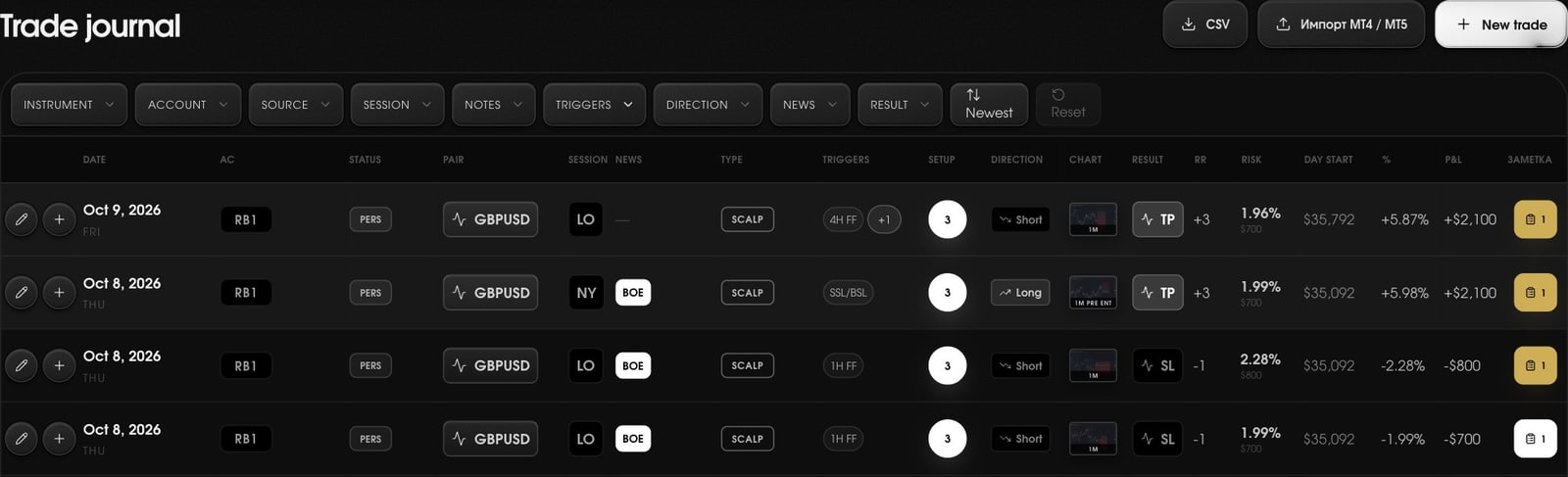
The known balance at the start of a day provides a basis for relevant trade calculations. In this example, Tuesday begins after Monday's -$2 event. A later balance is not a substitute for that earlier date's starting basis.
Read the Day Start explanation when a percentage or risk calculation looks unexpected. The snapshot used by one record and the complete money ledger have different roles.
An overlapping report should recognize the same imported cash identities rather than count the old events again. Check the preview and save result; a repeated upload is not a reason to add the same partial-exit money manually as well.
Preserve the action context beside the execution facts
Use comments and available images to describe what you planned and what action occurred. A sequence of exits establishes the reported actions, but it does not establish why you chose them. Mark any later recollection as a later addition.
MT4 can represent partial closes with separate tickets, so its handling should not be assumed to match this MT5 reconstruction. Identify the terminal and report structure before interpreting a trade count.
Before changing dates to make two screens look alike, write down what each screen is measuring. You can then check whether the difference follows from cash-event timing, final closure or missing source history, while preserving the actual events.