

An image collection can make a favourite setup's rules easy to see while leaving out much of its recorded history. To review the setup's outcomes, define which ideas belong to it before selecting examples.
Keep the review focused on completeness within this model. Record the definition, source coverage and unresolved labels. Comparing different setups is a separate question.

Write the definition before selecting records
Open the model material and identify the conditions that make an idea belong to it. Use wording that can be applied to a losing example as well as a profitable one. A model defined as “the clean version that worked” selects its result before the review starts.
The guide to documenting a model can help make the conditions explicit. If the definition changed, preserve when and how it changed in your own material. Do not treat a later improvement as though it had guided every old entry.
State what you can assess from available sources. Some older records may lack the timely image or plan needed to decide membership. An uncertain case should remain uncertain rather than being assigned according to its final P&L.
Set the full intended scope
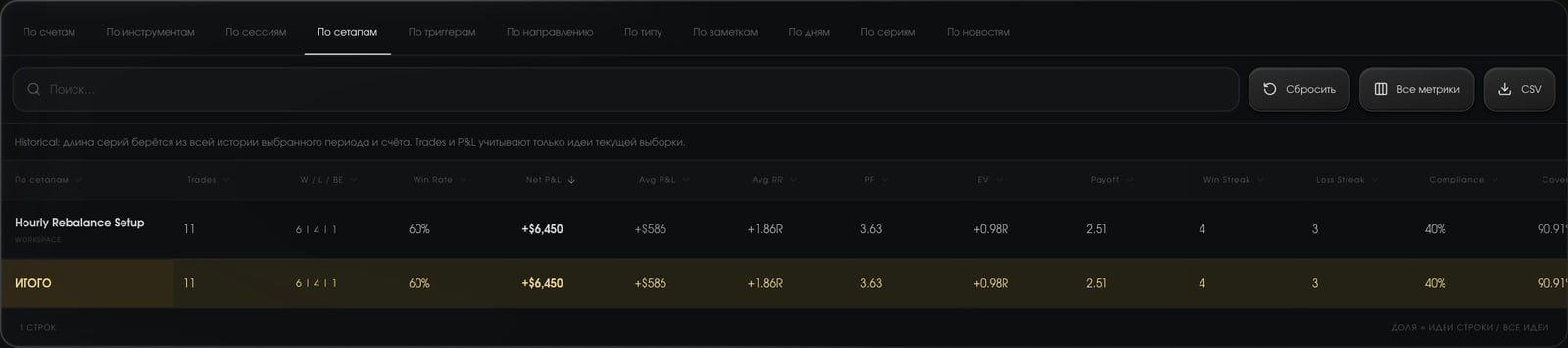
Choose explicit accounts and dates, then use the setup options in Deep Analytics. Check that the intended material is eligible in that view. A linkable Workspace material is not automatically included in every analytical setup option.
Retain the complete matching history under those boundaries, including SL, BE and ordinary small outcomes. Starting from a TP-only filter can help collect illustrations, but it cannot stand for a review of the full model sample.
Use the setup comparison guide for the count, money and R definitions, while keeping the present question on one model. Avoid adding instrument or session conditions simply because they improve the row you want to favour.
Inspect unclassified and conflicting records
Check the no-setup area and any known naming inconsistencies. A missing or ineligible reference can appear there. Read the original material before concluding that the idea had no model or deciding which one it should now receive.
Apply the same inclusion rule to gains and losses. If a label is wrong and a reliable source supports correcting it, preserve the reason for the correction in your review. Moving a losing record out of the model because its outcome looks unattractive would change the question.
Strategy analysis represents linked account executions as one idea with one setup. Which setup appears depends on the group's closed executions, so it need not match every member's label. Inspect the members if the association needs explanation.
Read outcomes and conduct independently
Check the number of completed ideas, actual P&L, known risk basis and gaps. Average RR is unsigned; Expected Value requires the full included signed R basis. A money total can remain known while a risk-based measure is unavailable.
Assess rule adherence only where the prior condition and action are supported. A losing idea may follow the model's procedure, while a profitable one may have a documented departure. Removing either solely because the outcome conflicts with your preferred story would make the sample less complete.
Keep an unassessed portion visible. The question “Was this idea associated with the model?” is not identical to “Was every rule followed?” Your notes should show which claim each record supports.
Give the image library a separate role
A setup image library can teach the model through selected examples. Caption why an image was chosen and whether it is a timely capture or later analysis. Useful teaching examples may include boundary cases or known departures.
The number of images is not automatically the number of independent ideas, and a polished collection is not proof of an edge. Several images can explain one event; many matching events may have no image suitable for a presentation.
Keep the full-sample review alongside the image library. Use one to account for the recorded history and the other to explain the model through selected views.
Save the selection and its limitations
Retain the model definition, dates, accounts, filter choices, count and unresolved membership cases. Write the finding in terms of this history. The next question may concern documentation quality, execution or a separate sample, without declaring the model validated.
Use the filter-overfitting check when changing the selection. Save why you changed a condition and which records it affected. The review does not require discarding the model or treating the next correctly labelled example as a promised profit.