

A useful trading record lets you identify the event, understand the money and examine the decision. You can build that record in layers. Start with the facts required to save it, then add the evidence needed for the question you intend to review.
In Santrade, the minimum required to save a record is the date, instrument, direction and trading account. Choose the optional details according to the review you want to do. Your own recording standard can be more detailed than the form's requirements.
Identify the event accurately
Check which account the entry belongs to and whether the date is correct. Similar instrument names or account labels can make an otherwise detailed description hard to interpret. Keep the identifiers consistent with the source you are using.
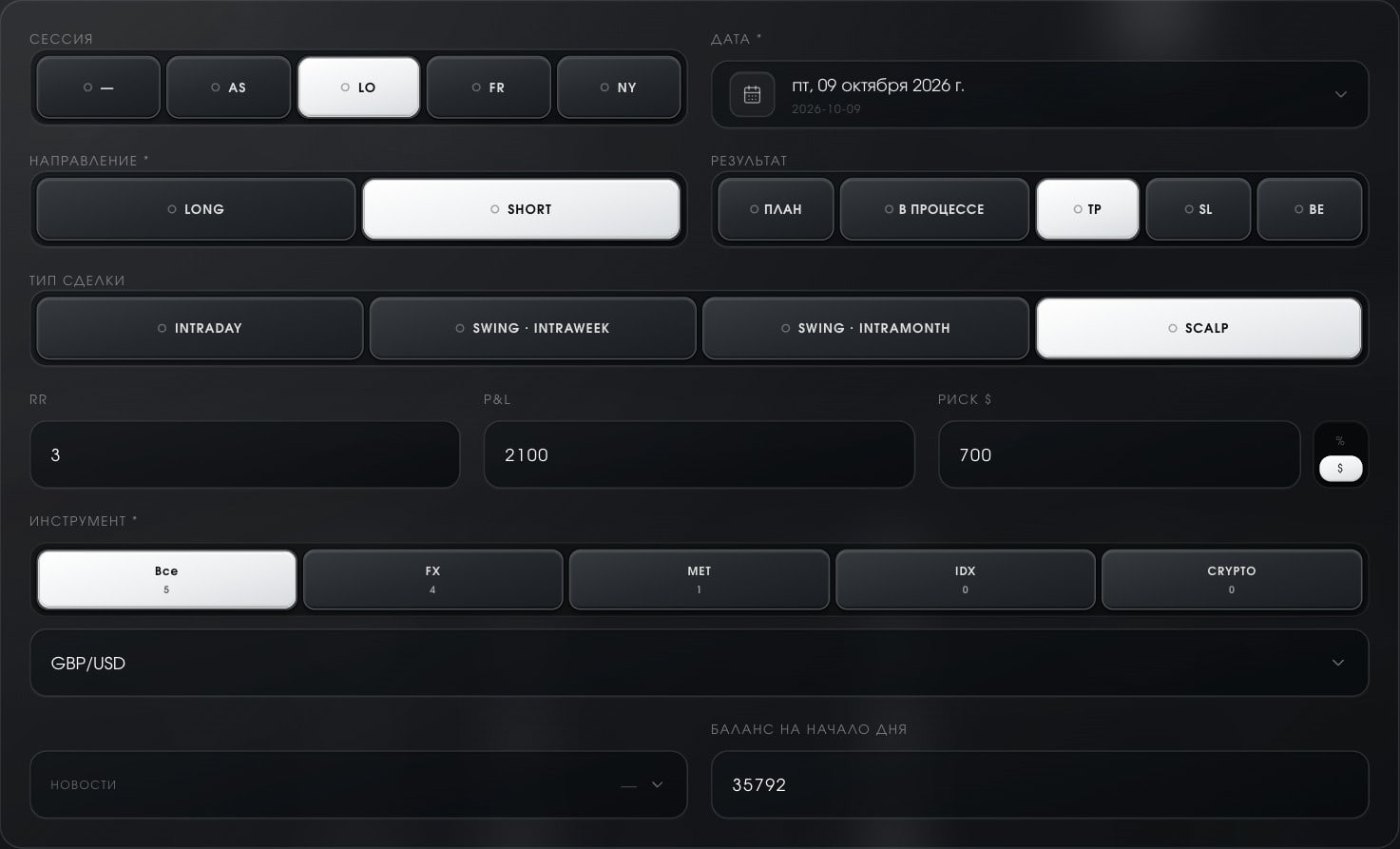
Use a status that matches what happened. A plan has no closed result; Processing describes an open record; TP, SL and BE are closed outcomes. A position entered on several accounts may belong to one idea while retaining separate financial facts for each execution.
Record the information you actually know. If you are describing an opportunity you watched but did not take, preserve it as a plan or written observation rather than assigning imaginary realized profit.
Keep risk and result interpretable
For a closed trade, retain the known cash P&L and the basis of the risk figure. Santrade accepts risk as a percentage or an amount. A percentage needs an appropriate positive Day Start balance to translate into money.
For example, $50 of known cash risk and +$100 of realized P&L give +2R. If the $50 risk has not been established, the cash result alone cannot establish that R value. Your usual risk does not tell you the risk of this particular trade.
Read the cash and percentage risk guide before switching units. The unit and number belong together. Changing the unit without checking the entered value can give it a different meaning.
Missing data can limit a calculation, and different metrics use different samples. Keep that limitation visible. Filling a blank field with an invented zero makes the row look complete while changing what the numbers describe.
Separate the model from the entry evidence
A setup describes the model or type of situation. Entry reasons describe the particular conditions you marked for the decision. Session, trading style and news labels offer further ways to organize suitable records.
Choose labels according to definitions you can apply again. A label such as "clear condition" needs enough explanation to distinguish it from a vague impression. The guide to setups and entry reasons shows how those parts can be kept separate.
These choices are supplied by the person keeping the journal. A supported terminal report does not automatically recover your intended model, psychological motive or news interpretation from the price history.
Write the action and preserve the evidence
Keep the specific circumstances in the trade description. Santrade provides a general description of up to 1,000 characters and separate chart descriptions. A short, precise record can identify the plan, action and open question without narrating an entire session.
A sample comment: "The plan specified event A. I entered before A was established. The saved image shows the entry area; I need to check the sequence against the available source."
Attach images that help examine the decision and label when they were created. An image marked up later contains different information from one saved beforehand. The guide to trade-review screenshots helps you choose a useful set.
Reusable Notes can hold observations shared by several cases. Their common text is different from the individual circumstances of one execution. Where a category assesses compliance or a violation, use an established rule and suitable evidence for that assessment.
Set a personal standard you can check
Decide what you need before a review. Your standard might call for a named setup, known risk where available, one explanation of the action and an image that helps inspect it. These are your chosen requirements; the application does not make those optional fields mandatory.
For an older record, mark which information came from a contemporary source and which was added later. Leave a specific question where the evidence is insufficient. That makes the next task clearer than a general instruction to "complete the journal".
Return to plan versus execution when the record is ready to read. Compare the same kind of action with the same stated rule across different outcomes. A profitable result does not supply a missing explanation.
Before finishing, reopen the saved entry and ask whether you could understand it without remembering the session. If the identifiers, financial basis and decision evidence are clear, the record is ready to support a meaningful review. If one part is missing, you have a concrete next recording task.