

Your broker's history can establish what was executed and report the money associated with it. To review why you entered, you also need your own record of the decision. A trading journal keeps that explanation alongside the execution facts.
In Santrade, supported MetaTrader reports provide execution and financial facts. The import does not supply your setup, intended risk, entry reasons, session label, personal notes or saved charts. These are separate additions, each serving a question you may want to ask later.
Read what the report already establishes
Begin with the actual report rather than a recollection of the total. Check the account, dates, positions and reported costs. A net result can include charges that would be missed if you copied only a headline profit figure.
The unit also matters. A position may have several executions, and one idea may be implemented on several accounts. Before interpreting a count as repeated decisions, establish what each imported record represents.
Broker products differ, and some offer their own notes or analysis. For a Santrade import, check which information comes from the supported report and which information you need to add yourself.
Turn the missing context into a question
Choose something you genuinely want to review. Was an entry condition present? What event was supposed to cancel the plan? Why did you close before the recorded exit condition? Each question calls for its own evidence.
Suppose two independent trades each lost $100. The shared cash outcome says little about whether both followed the same rule. One might match a saved plan, while the other needs a comment explaining an unplanned action. The combined loss is $200; the decisions still require separate reading.
Writing the question first also keeps the record manageable. If you are reviewing exits, an explanation of the exit and a relevant chart may matter more than a long account of every market observation.
Connect the explanation to the right record
Santrade lets you add a description, setup, entry reasons and Notes links to a trade. Keep the facts of this particular event in its own comment. Use a reusable note for an observation whose wording applies across its linked records.
A sample comment could read: "The plan specified event A. I closed at event B. The available screenshot shows B; I have not established when A appeared." It identifies an action and a remaining question without inventing a complete explanation.
The guide to useful trade comments develops this approach. A label alone can help you find related cases, but the label does not supply all the circumstances of an individual decision.
Preserve what was known at the time
A chart captured before a decision and one marked up after the trade have different roles. Give each a caption that explains when it was created and what it shows. A later chart can support a review while containing information unavailable at entry.
If an earlier image is missing, say so. The journal cannot reconstruct an unsaved screenshot or establish your exact thought from the final price path. Note which image you would need to save for the next review.
Use screenshots for trade review to decide which images answer your question. Filling every available slot is optional; the point is to keep evidence that you can read again.
Add a small record after importing
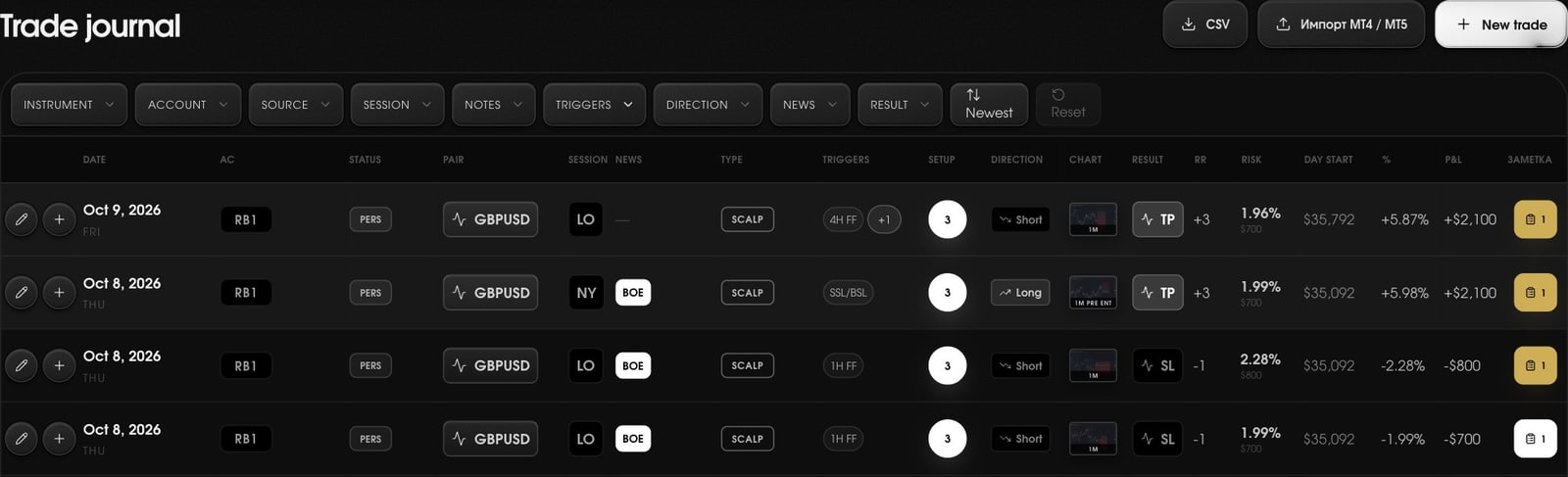
First check the imported facts. Then add the context you can support: the chosen model, known risk, relevant entry reasons and a short explanation. The post-import checklist separates these additions from what the report already provides.
Leave uncertain values visible as uncertainties. A missing risk amount limits an R-based calculation. Substituting a familiar number merely to fill the field creates a different record from the one your source supports.
For older trades, distinguish a contemporary note from a later recollection. Both can be worth retaining, but they provide different evidence about what you knew when making the decision.
Return to the original question
At review, open the record alongside its plan and available images. Compare the action with the condition you had written, using the same rule regardless of the money outcome. A profitable result and a rule assessment describe different aspects of the event.
The plan-versus-execution review gives that comparison a clear structure. You can finish with an established fact, an unresolved point and one change to the way you record future cases.
Keep the broker report as the source for its execution facts. During review, check whether your own additions explain the decision and identify what is still missing. The financial result alone cannot supply that explanation.